
Registering as an Alternative Trading System is the correct compliance route for any crypto venue that trades tokens the SEC treats as securities. Under U.S. law, an ATS is a non-exchange trading venue that matches buy and sell orders for securities, and it cannot operate that way without registering as a broker-dealer, joining a self-regulatory organization like FINRA, and filing Form ATS. Skip that step while listing security tokens, and the exchange is running an unregistered securities market.
TL;DR:
- Registering as an ATS is mandatory for crypto platforms trading tokens classified as securities and requires SEC broker-dealer registration, FINRA membership, and Form ATS filing.
- A crypto venue becomes an ATS by matching securities orders through a process that involves continuous updates, trade surveillance, AML/KYC integration, and regular audits.
- Successful compliance depends on detailed token classification, thorough policies, and infrastructure upgrades, with registration processes typically taking several months.
- Unregistered platforms risk enforcement actions, weak investor protection, and lack of transparent disclosures, increasing legal and operational vulnerabilities.
- Decentralized protocols face uncertain ATS status, and given regulatory risks, projects should assume securities law applies and develop compliant governance structures from the outset.
Table of Contents
- What Counts as an Alternative Trading System Under U.S. Law
- How ATS Registration Applies to Crypto Exchanges
- What Operating a Crypto ATS Actually Requires Day to Day
- A Readiness Checklist Before Filing
- What Enforcement Patterns Actually Teach Compliance Teams
- Crypto ATSs Versus Traditional Crypto Exchanges
- Regulatory Challenges and Recent SEC Enforcement Trends
- Why ATS Status Matters for Investor Protection
- Technology Infrastructure and Security for Crypto ATSs
- Decentralized ATS Models and Where Regulators Stand
- Regulated Access Versus Product Agility
- How Murphy’s Law Supports ATS Readiness and Regulatory Defense
- Sources
- FAQ
What Counts as an Alternative Trading System Under U.S. Law
An ATS is a trading venue that matches buy and sell orders for securities without holding the legal status of a national securities exchange, such as the New York Stock Exchange or Nasdaq. That distinction matters because exchanges face a heavier, self-listing regulatory framework, while ATSs operate under a lighter but still substantial compliance regime layered on top of broker-dealer rules. Investor frames this as the core structural difference investors need to understand before trading on either type of venue.
Three requirements convert a matching engine into a lawful ATS:
- Broker-dealer registration with the SEC, since an ATS operates as a broker-dealer rather than an exchange.
- SRO membership, almost always with FINRA, which examines the firm’s operations and enforces conduct rules.
- Form ATS filing, disclosing the venue’s operations, conflicts of interest, and subscriber base to the SEC before launch, with amendments required whenever material details change.
Larger platforms trading National Market System stocks file Form ATS-N instead, a more detailed disclosure regime. Crypto venues rarely trigger ATS-N, since most don’t trade NMS-listed equities, but any platform considering dual-listing traditional securities alongside tokens needs to assess that threshold early.
How ATS Registration Applies to Crypto Exchanges
Token classification is the trigger. Once a digital asset meets the Howey test and gets treated as a security, the venue trading it faces the same rules as a stock brokerage. Registering as an ATS becomes a primary compliance path for listing and trading those assets, and it gives the platform a lawful, regulated secondary market instead of an improvised one.
That regulated status solves a real liquidity problem. Security tokens issued under exemptions like Regulation D or Regulation A often carry resale restrictions and holding periods. A registered ATS gives holders a legitimate venue to trade once those restrictions lift, rather than forcing them into gray-market peer-to-peer crypto trading arrangements that carry their own fraud exposure.
Operators facing this fork in the road generally choose one of three paths:
- Register as an ATS and accept the full broker-dealer compliance load.
- Restrict listings to tokens with a defensible non-security analysis, avoiding ATS status entirely.
- Pursue a narrower registration or exemption while limiting trading volume or subscriber types.
A limited-listing strategy is not a shortcut. It demands rigorous, token-by-token legal analysis, because a wrong call on a single asset can expose the platform to the same enforcement risk as running an unregistered exchange outright.
What Operating a Crypto ATS Actually Requires Day to Day
Registration is the starting line, not the finish. Once live, an ATS carries continuous obligations that reshape how a crypto platform runs internally.
- File amendments promptly. Any material change to matching logic, fee structure, or subscriber access requires an updated Form ATS filing, not a quiet backend change.
- Build real trade surveillance. Regulators expect documented systems that flag manipulative order patterns, not a spreadsheet reviewed after the fact.
- Maintain order-handling and market-access controls. Every order path needs documentation showing how it is routed, matched, and recorded.
- Integrate AML and KYC screening directly into the trading stack, not as a bolt-on compliance afterthought, since suspicious activity reporting obligations apply the moment securities-like assets move on the platform.
- Expect SRO audits. FINRA reviews ATS operations, and gaps between what Form ATS discloses and what the system actually does are a common audit finding.
This operational drag is real: Form ATS filings and broker-dealer obligations create ongoing reporting and disclosure duties that push crypto startups toward the compliance posture of a traditional financial institution, whether their engineering team is ready for that or not.
Pro Tip: Treat trade reconstruction capability as a launch requirement, not a later upgrade. If your system can’t produce a complete, timestamped record of any single trade on demand, you are not ready for an SRO exam.
A Readiness Checklist Before Filing
Operators weighing registration should work through a defined sequence rather than jumping straight to paperwork.
- Classify every token you plan to list or already list, documenting the securities analysis for each.
- Draft core policies: a surveillance plan, a conflicts-of-interest disclosure, and written order-handling procedures.
- Upgrade infrastructure for recordkeeping, supervision, and vendor relationships that support broker-dealer obligations.
- File Form ATS and pursue FINRA membership in parallel, since the FINRA application process runs on its own review timeline independent of the SEC filing.
- Plan for months, not weeks. Broker-dealer registration and SRO membership routinely take several months, and costs scale with legal fees, technology rebuilds, and compliance staffing.
Pro Tip: Bring in securities counsel before you draft your surveillance plan, not after. A plan written without regulatory input almost always needs a costly rewrite once FINRA reviews it.
What Enforcement Patterns Actually Teach Compliance Teams
Recurring enforcement themes in the crypto trading space share a common shape: a platform treats its matching engine as a technology product rather than a regulated market, and only recognizes the gap once regulators come asking. The SEC has repeatedly warned that online platforms trading securities-like instruments without proper registration may be operating unlawfully, regardless of how the platform brands itself.
Counsel’s role in this process is less about filling out forms and more about stress-testing the business model before a regulator does it for you. That means reviewing token classifications line by line, drafting surveillance and conflicts policies that match what the system actually does, and preparing management for how a FINRA exam actually unfolds.
Firms navigating SEC crypto regulations benefit from counsel with direct litigation experience against regulators, as well as advisory experience.
Crypto ATSs Versus Traditional Crypto Exchanges
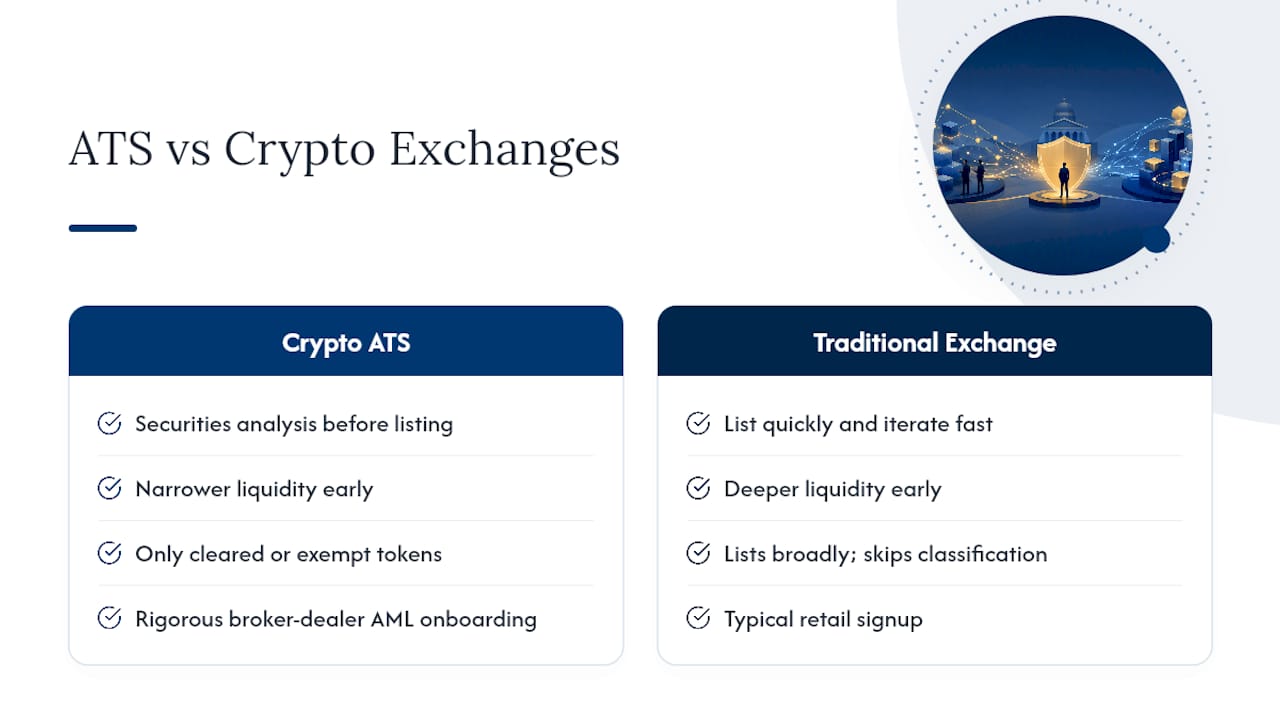
A registered ATS and a typical crypto exchange solve different problems, even when their trading screens look identical. Traditional crypto exchanges optimize for speed to market: list a token, open trading, iterate fast. A crypto ATS trades that speed for legal footing, since every listing decision routes through securities analysis before it ever reaches a customer.
Liquidity tells the real story. Unregistered exchanges often achieve deeper liquidity early because they list broadly and skip the classification bottleneck. A registered ATS typically launches with a narrower asset list, since only tokens that clear securities analysis, or that qualify under an exemption with lifted restrictions, belong on the platform. That liquidity gap tends to close over time as more issuers seek a lawful secondary market for restricted tokens, but it is real in the near term.
User experience diverges too. ATS subscribers usually go through more rigorous onboarding, since broker-dealer suitability and AML obligations apply in ways a typical retail crypto exchange signup does not. Order types and market data may also look more conservative, mirroring equity market conventions rather than the 24/7, high-leverage features common on offshore crypto exchange alternatives.
The trade-off is legal durability. A registered ATS is far less likely to face an existential enforcement action over its core listing business, because its listings have already passed regulatory scrutiny. Understanding the difference between decentralized trading platforms and registered venues helps operators pick the right structure before building.
Regulatory Challenges and Recent SEC Enforcement Trends
The SEC’s enforcement posture toward crypto trading venues has centered on a consistent theory: a platform that matches buy and sell orders for securities is running an exchange or ATS function, whatever it calls itself. The SEC’s public enforcement statement on online trading platforms makes that theory explicit, warning operators that registration obligations attach based on function, not branding.
For crypto specifically, the friction point is almost always token classification. A platform may believe its listed assets are utility tokens, only to have the SEC apply the Howey framework and reach a different conclusion. That mismatch is where most enforcement actions originate, not from a deliberate decision to dodge registration.
Compliance teams should also watch for acronym confusion in this space. Some crypto projects use “ATS” as a token ticker or brand name entirely unrelated to SEC-regulated trading infrastructure, and mixing up the two creates real compliance risk when counsel or regulators assume a project is discussing venue registration when it is not. Distinguishing ATS crypto tokens that merely share the acronym from actual ATS infrastructure is a basic due-diligence step that gets skipped more often than it should.
Jurisdictional overlap adds another layer. Some enforcement actions touch both SEC and CFTC authority depending on how a token or derivative is structured, and operators need clarity on which regulator’s rules actually govern their specific product before assuming ATS registration alone resolves their exposure.
Why ATS Status Matters for Investor Protection
Registered status changes the risk profile for anyone trading on the platform, not just the operator’s legal exposure. An ATS subject to FINRA oversight faces recurring audits, documented surveillance requirements, and disclosure obligations that give regulators a paper trail if something goes wrong. An unregistered venue offers none of that, which means investors have far less recourse when a platform fails, freezes withdrawals, or turns out to be running manipulated order flow.
Form ATS disclosures also give subscribers visibility into conflicts of interest, something rarely available on unregistered platforms where the operator may trade against its own customers without disclosure. That transparency requirement is a meaningful investor protection, even though it rarely gets attention compared to headline-grabbing hacks or collapses.
The practical reality is that most crypto fraud recovery cases involve platforms that never sought any registered status at all. Victims of failed or fraudulent unregistered platforms typically have far weaker legal footing than those trading on a regulated ATS, since there’s no SRO record, no disclosed conflicts framework, and often no real corporate accountability structure to pursue. That gap is exactly why crypto fraud recovery litigation so often starts with tracing assets through entities that were never subject to any securities oversight in the first place.
Technology Infrastructure and Security for Crypto ATSs
A crypto ATS needs infrastructure built for two audiences at once: fast-moving traders and slow-moving regulators. That tension shapes almost every technical decision.
Trade surveillance systems have to run continuously, flagging wash trading, spoofing, and layering patterns in real time rather than in a nightly batch job. Order-handling systems need full audit trails, timestamped to a standard that survives a FINRA request for trade reconstruction months after the fact. Custody architecture matters just as much: an ATS handling security tokens needs segregation between customer assets and operational funds that meets broker-dealer supervision expectations, not just crypto industry norms.
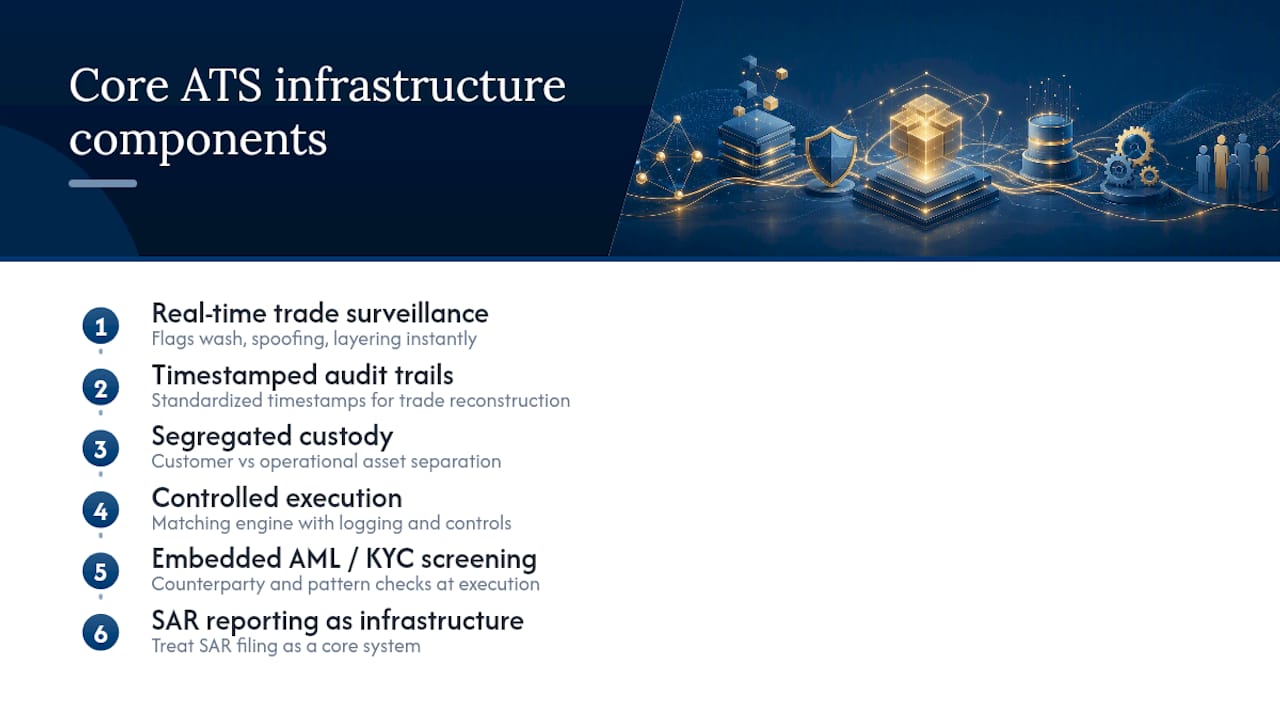
Execution infrastructure is where many operators underestimate the lift. Building a compliance-friendly trade execution setup often means re-architecting matching engines that were originally built for speed alone, adding logging, controls, and reconciliation layers after the fact rather than by design.
AML and KYC screening belongs inside the trading stack itself, checking counterparties and transaction patterns as trades execute rather than as a periodic batch review. Given the reporting obligations that apply once suspicious activity appears, platforms should treat SAR filing processes as core infrastructure, not an afterthought bolted onto compliance later.
Decentralized ATS Models and Where Regulators Stand
Decentralized trading platforms raise a genuine open question: can a protocol with no central operator still function as an ATS under securities law? The SEC’s enforcement posture suggests function matters more than form. If a smart contract or protocol matches buy and sell orders for securities, the entities that build, control, or profit from that protocol may face the same registration analysis as a centralized exchange, even without a traditional corporate structure sitting behind the matching logic.
This creates real strategic tension for decentralized finance projects. Full decentralization, where no single party controls the protocol or its upgrade keys, is the strongest argument against ATS classification, but few projects achieve that in practice. Most retain some form of governance token voting, upgrade authority, or fee-collection mechanism that regulators can point to as centralized control.
Operators exploring decentralized trading platforms as an alternative to formal ATS registration should treat that path as unsettled, not as a clean escape from securities law. The safer approach for any project with meaningful centralized control is to assume ATS-style obligations apply and build DeFi compliance into the protocol’s governance from the start, rather than retrofitting it after a subpoena arrives.
Regulated Access Versus Product Agility
ATS registration makes sense the moment a platform’s token mix includes assets that plausibly qualify as securities and the operator wants durable, defensible market access rather than a growth strategy built on regulatory luck.
Staying unregistered isn’t automatically reckless, but it concentrates risk into a single point of failure: one enforcement action can shut the platform down entirely. Over-restricting listings to dodge ATS status carries its own cost, cutting off legitimate liquidity and revenue. The right call depends on the specific token mix and how much runway the business has to absorb a compliance buildout, not on a generic industry preference.
— Mark
How Murphy’s Law Supports ATS Readiness and Regulatory Defense
Building toward ATS registration, or defending a platform that skipped it, is not a paperwork exercise. It’s a legal strategy question that benefits from counsel who has actually litigated against regulators, not just filled out forms alongside them.
Some legal firms work with crypto exchange operators on the compliance side, drafting surveillance plans, conflicts disclosures, and token classification analyses that Form ATS filings and FINRA membership applications require. Such firms may also defend businesses facing regulatory inquiries, drawing on litigation experience from crypto matters to shape defense strategies rather than reactive scrambles. If your platform has received a request for information or subpoena, review how to respond to a crypto regulatory inquiry before you reply to anyone. For operators earlier in the process, the firm’s crypto compliance consulting work starts with an assessment of your token mix and current exposure, then builds toward a registration or restructuring plan that fits your actual business, not a generic checklist. Reach out to start that assessment before a regulator forces the timeline for you.
This article is general information, not a substitute for advice from a qualified lawyer. Consult a qualified legal professional about your own circumstances before acting on anything here.
Sources
FAQ
What is an ATS under FINRA rules?
An ATS is a trading venue that matches buy and sell orders for securities without exchange status, but it must still register as a broker-dealer, join FINRA as its SRO, and file Form ATS disclosing its operations.
What are examples of alternative trading systems?
Traditional examples include dark pools and electronic communication networks used for equities trading; in crypto, a registered ATS functions similarly but limits listings to tokens that clear securities analysis or qualify under an exemption.
What is the best crypto trading platform in the U.S.?
There’s no single “best” platform, since the right choice depends on whether the tokens involved are securities, what liquidity and features you need, and whether you prioritize regulated status or broader token access.
What is the best U.S. trading platform for security tokens specifically?
A registered ATS is the only lawful venue type for trading tokens that qualify as securities, since it’s the specific registration category built for that purpose under SEC and FINRA rules.
How long does crypto ATS registration typically take?
Broker-dealer registration and FINRA membership routinely take several months in parallel with the Form ATS filing, with timelines driven by how prepared the surveillance plans and disclosure documentation are before submission.