
Full recovery is rare, but partial recovery is realistic when victims act fast and preserve evidence properly. Success depends far more on speed and traceability than on the size of the loss. The first move is not calling an exchange. It is preserving every transaction hash, filing an FBI IC3 referral, and retaining courtroom counsel, such as Liam Murphy, Esq., who can move for emergency freezes and subpoenas before the trail goes cold.
TL;DR:
- Acting within the first 72 hours significantly increases the chance of recovering stolen assets from a bridge hack through emergency legal measures.
- Tracing stolen funds hop through multiple wallets and mixers, with progress measurable in weeks, and full recovery potentially taking over a year.
- Effective legal recovery requires a coordinated strategy involving forensic evidence, court orders like TROs, and swift filing before assets move further or become harder to trace.
- Insurance coverage for individual crypto victims is limited, making legal claims and exchange freeze requests the primary recovery methods.
- Choosing experienced attorneys with real courtroom and forensic expertise is critical, as outcomes heavily depend on fast, strategic legal action rather than unlicensed recovery services or guarantees.
Table of Contents
- Bridge Hacks Legal Recovery: The First 72 Hours
- What Legal Tools Actually Recover Stolen Funds?
- How Does On-Chain Tracing Lead to a Frozen Account?
- Civil Claims and Enforcement: Turning a Traced Wallet Into Recovered Funds
- How Long Does Bridge Hack Recovery Take, and What Does It Cost?
- How Do You Choose the Right Attorney for a Bridge Hack Case?
- What Defenses Do Alleged Perpetrators Raise in Bridge Hack Cases?
- Why Legal Recovery Depends on Cybersecurity Partners
- Does Insurance Cover Stolen Crypto From a Bridge Hack?
- Have Bridge Hack Victims Actually Recovered Funds?
- Author perspective: why speed and courtroom experience matter
- How Murphy’s Law Handles Bridge Hack Recovery Cases
- Sources
- FAQ
Bridge Hacks Legal Recovery: The First 72 Hours
The window that determines whether your bridge hack legal recovery has a chance is measured in hours, not weeks. Emergency freeze letters, John Doe subpoenas, and IC3 referrals filed within days consistently recover more value than claims filed later, because stolen assets keep moving and mixing the longer you wait.
Here is what to do in order:
- Stop the bleeding. Revoke every wallet approval tied to the compromised contract using Revoke, then move remaining assets to a fresh, uncompromised wallet.
- Isolate the device. If a browser extension, seed phrase, or signing session was compromised, assume the device itself is unsafe until a forensic partner clears it.
- Preserve everything. Save full transaction hashes (not truncated versions), the drainer or bridge contract address, wallet addresses on both ends, screenshots of the approval prompt, and timestamps for every step.
- File with IC3. Submit a report to the FBI’s Internet Crime Complaint Center immediately, and keep the confirmation number. Local field office referrals can follow.
- Retain counsel before you contact exchanges. Freeze letters and tracing requests carry far more weight coming from an attorney who can back them with a subpoena than from an individual victim.
Exchanges will not act on a polite email alone. They need a tracing report showing the exact path of funds, the receiving address, and timestamps that match their own transaction logs. That packet is what turns a freeze request from a suggestion into something a compliance desk can actually process.
Pro Tip: Do not negotiate with the platform or the alleged attacker on your own, and do not hire an outside forensic firm before talking to counsel. Anything you say, and any wallet moves you make, can become evidence later, and premature action can create OFAC exposure or spoliation problems.
What Legal Tools Actually Recover Stolen Funds?
Bridge hack recovery runs through a small set of court mechanisms, and understanding what each one does helps you evaluate whether your case has the pieces it needs.
- Temporary restraining orders (TROs) and preliminary injunctions freeze identified assets before a defendant can move them again. Courts grant these on an emergency basis when you can show funds are traceable and at risk of disappearing.
- John Doe subpoenas and expedited discovery let you sue an unknown defendant by wallet address, then subpoena exchanges for the KYC data tied to that address before you even know the person’s name.
- Seizure warrants are a law enforcement tool, not a civil one. They require government involvement and typically move slower than a private TRO, but they carry criminal weight civil orders lack.
- Turnover proceedings, conversion, and constructive trust claims are the remedies that actually compel a third party holding your traced funds, often an exchange, to release them to you.
These tools work best when integrated into a single litigation strategy from the outset, rather than pursued piecemeal after the trail has cooled. A TRO filed the same week funds move to an exchange gives you leverage a demand letter never will.
How Does On-Chain Tracing Lead to a Frozen Account?
Tracing is the evidence layer underneath every legal tool above. A forensic analyst maps the stolen funds hop by hop, from the bridge exploit through any intermediate wallets to wherever they land, usually a centralized exchange with KYC on file.
That trace becomes the exhibit attached to your freeze letter, your TRO motion, and your subpoena. Exchanges will not act on a bare accusation.
- Compliance desks typically need the full transaction path, the destination address, and exact timestamps before they will even open an internal review.
- A subpoena backed by a court order gets a materially faster response than an unsolicited email from a victim.
- Issuers like Circle can technically freeze USDC at the smart contract level, but they generally will not do it on a private request. They want a lawful trigger, a court order, a law enforcement hold, or a sanctions’ designation, before acting.
That is the practical trap industry guidance repeatedly warns about: victims wait for a platform to “just freeze it,” when the real task is engineering the order that gives the platform legal cover to act. Mixers, fast cross-chain bridging, and sanctioned wallet clusters are the biggest obstacles once funds move past the first hop.
Civil Claims and Enforcement: Turning a Traced Wallet Into Recovered Funds
A judgment is a piece of paper until it is collected. Most bridge hack cases plead a combination of conversion, unjust enrichment, and constructive trust, often against Doe defendants identified only by wallet address until discovery unmasks them.
Getting a judgment is genuinely only half the job. Effective recovery requires a real collection strategy, built around:
- Restraining notices served on exchanges or banks holding traced funds.
- Post-judgment debtor examinations to force disclosure of assets.
- Fraudulent-transfer claims when a defendant moved assets to relatives or shell entities after the hack.
- Turnover proceedings compelling a third-party custodian to release specific traced assets.
- Veil-piercing claims where the facts show a shell company was used to obscure ownership.
Enforcement planning has to start before you ever file, not after you win. The asset tracing, exchange discovery, and third-party subpoenas you use to build the complaint are the same evidence you will need later to actually collect. Waiting until judgment to think about enforcement is how winners end up with an uncollectible piece of paper. A constructive trust claim filed alongside conversion gives you a stronger equitable hook on specific traced coins rather than just a money judgment against a defendant who may have nothing left.
How Long Does Bridge Hack Recovery Take, and What Does It Cost?
Set your expectations now: meaningful recovery in a complex bridge hack case commonly runs from several months to more than a year, particularly when funds crossed multiple chains before landing at an exchange.
Cost drivers scale with complexity:
- Forensic tracing fees, which rise sharply once funds pass through multiple bridges or mixers.
- Expedited discovery and emergency TRO motions, which require rapid, often after-hours legal work.
- Post-judgment enforcement actions, which can rival the cost of the original litigation.
Litigation finance is worth discussing with counsel early. Non-recourse funders can cover tracing and filing costs upfront in exchange for a share of whatever is recovered, shifting the financial risk off the victim. Ask about contingency, hourly, and hybrid fee arrangements too. Each carries tradeoffs in cost certainty versus your share of any eventual recovery.
How Do You Choose the Right Attorney for a Bridge Hack Case?
Ask three things before signing anything: has this attorney actually argued a TRO or preliminary injunction in a crypto case, do they have real forensic partners rather than a generic “recovery team,” and how is the fee structured?
- Ask for specific courtroom experience, not just “crypto litigation” on a website.
- Ask who does the on-chain tracing and whether that work product will hold up as evidence in court.
- Get the fee arrangement in writing before any work begins.
- Ask for case examples, even anonymized ones, showing a similar fact pattern.
Watch for red flags that separate a licensed law firm like Murphy’s Law from an unregulated “recovery service”: guaranteed recovery promises, upfront non-refundable “recovery fees” with no legal work attached, firms that are not actually licensed to practice law, or anyone asking you to move remaining assets before a lawful order exists.
Pro Tip: Bring your full transaction hash list, approval screenshots, a written timeline, and any messages from the attacker or a “recovery agent” to your first consultation. The more organized your evidence, the faster counsel can evaluate whether an emergency motion is realistic.
What Defenses Do Alleged Perpetrators Raise in Bridge Hack Cases?
Defendants in bridge hack litigation rarely deny the exploit happened. They fight jurisdiction, identity, and characterization instead.
The most common defense is a straightforward denial of identity: “you have the wrong wallet, and you cannot prove I controlled it.” This is exactly why forensic tracing evidence, not just blockchain records, matters so much. A trace that only shows fund movement without linking a specific person to the wallet through exchange KYC data, IP logs, or device forensics leaves a gap defendants will exploit.
Jurisdictional challenges come next. A defendant may argue the U.S. court has no authority over conduct that occurred entirely on decentralized infrastructure with no clear U.S. nexus, or that a smart contract “exploit” was actually a permissible use of publicly available code (the so called “code is law” argument some DeFi defendants raise). Courts have not uniformly rejected or accepted that theory, which is part of why filing quickly under a coherent legal cause of action matters.
Some defendants raise counterclaims alleging the plaintiff’s own security practices contributed to the loss, or that the bridge protocol itself, not the plaintiff, bears liability for inadequate security controls. Others argue the funds were legitimately obtained through a permitted arbitrage or MEV strategy rather than an exploit. None of these defenses eliminates your claim, but each one is a reason your tracing evidence and pleadings need to be built to withstand scrutiny from the start, not patched together after a motion to dismiss lands.
Why Legal Recovery Depends on Cybersecurity Partners
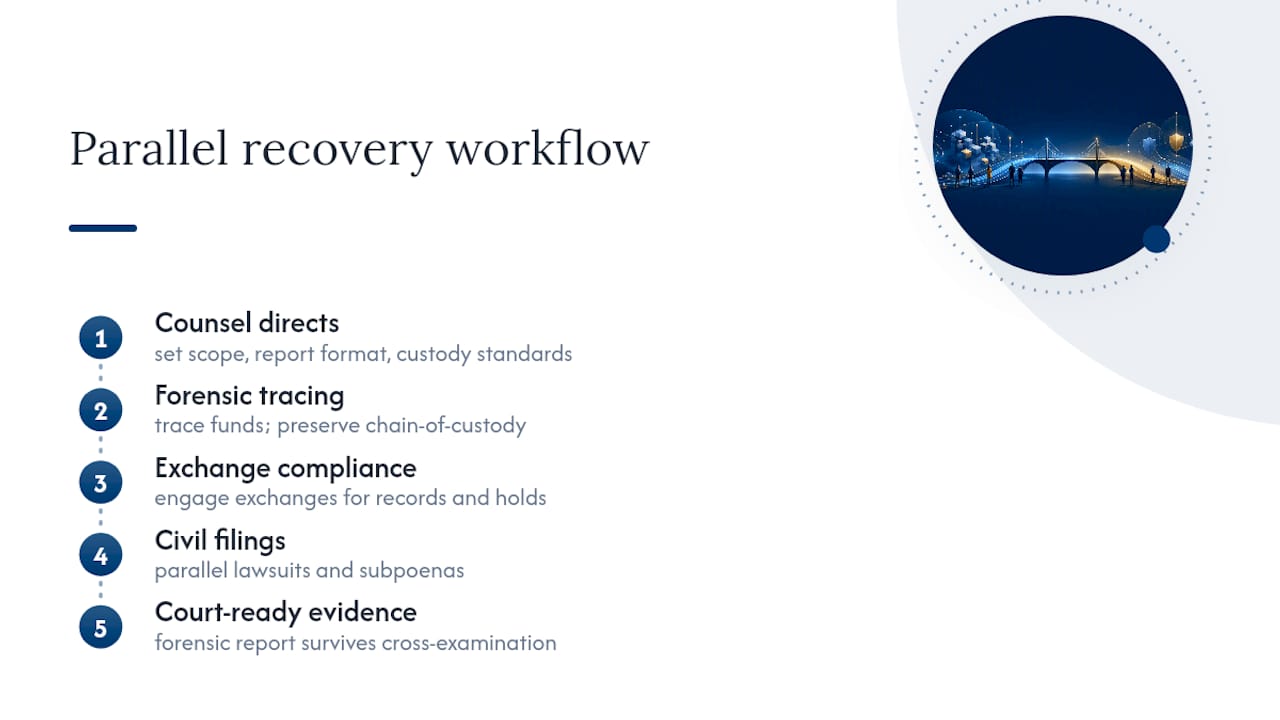
Attorneys do not perform blockchain forensics themselves. A serious legal recovery effort runs on a coordinated relationship between counsel and incident response specialists who can trace funds, analyze the exploited contract, and produce evidence formatted for a court filing.
This division of labor matters more than most victims realize. A forensic report built for a blog post or a public disclosure looks different from one built to survive cross-examination or support a subpoena request. Counsel needs to direct the scope of the forensic engagement from day one: what needs to be preserved, what format the report needs to take, and what chain-of-custody standards apply so the evidence is not thrown out later on a technicality.
Practical recovery programs tend to layer multiple pressure points at once: private forensic tracing, exchange compliance engagement, and parallel civil filings working together rather than sequentially. That means your forensic partner is talking to your attorney throughout, not handing over a finished report weeks later.
This is also where hiring an unlicensed “recovery service” independently of counsel creates real risk. If that firm accesses wallets, contacts the attacker, or makes representations without coordinating with legal counsel, it can taint evidence or create liability that undermines the very case you are trying to build.
Does Insurance Cover Stolen Crypto From a Bridge Hack?
Most individual crypto holders have no insurance covering a bridge exploit, and that gap is one of the biggest misconceptions victims run into. Standard homeowner’s or renter’s policies almost never cover digital asset theft, and even specialized crypto insurance products remain limited in availability and scope for individual retail holders.
Some centralized exchanges and custodians carry institutional insurance covering assets held on their platform, but that coverage typically protects the platform’s own custodial wallets and internal security failures. It generally does not extend to a self-custody bridge transaction gone wrong, or to funds you personally moved through a compromised bridge interface.
A small number of specialty insurers and DeFi protocol treasuries offer coverage pools for smart contract failure, but these products are protocol-specific, often capped, and rarely purchased by individual users in advance of a hack. If you are a bridge hack victim now, insurance is unlikely to be your recovery path. Legal claims against traceable defendants and exchange freeze mechanics remain the primary route. Going forward, ask any platform you use whether it carries institutional coverage and what specifically that coverage excludes, because the exclusions are usually where individual losses fall.
Have Bridge Hack Victims Actually Recovered Funds?
Recovery successes in bridge hack cases share a common pattern: fast reporting, strong tracing, and funds that landed at a cooperative, regulated exchange rather than disappearing into a mixer.
Public post-incident updates from affected protocols illustrate the realistic shape of these outcomes. Recovery efforts described in Hyperbridge’s public update show that even well-resourced teams with strong forensic capability often measure real progress in weeks for the initial trace, and over a year for anything approaching full resolution. That is not a discouraging data point. It is a realistic one, and it should shape what you expect going in.
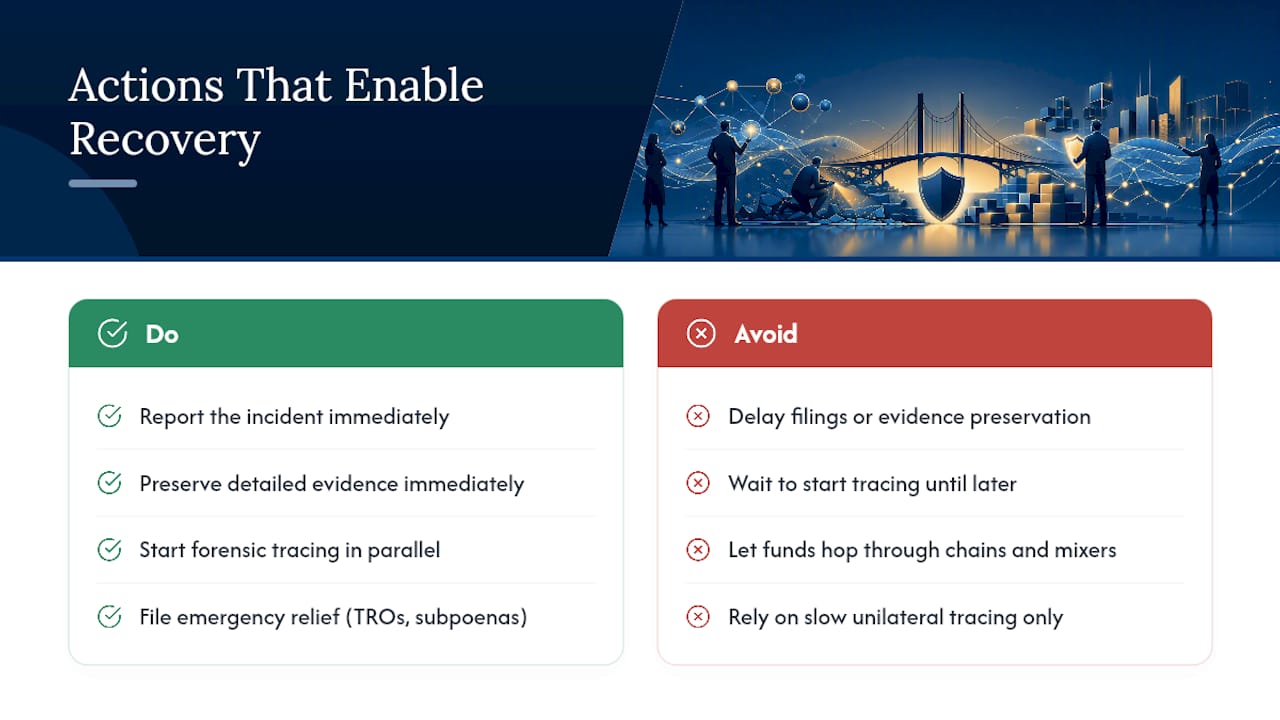
The pattern that separates a partial win from a total loss is consistent across the cases that do resolve favorably: victims (or their counsel) preserved detailed evidence immediately, filed for emergency relief before funds moved further, and kept forensic tracing running in parallel with the legal filings rather than waiting for one to finish before starting the other. Cases where funds sat untouched at a single exchange for even a short window tend to resolve faster and more completely than cases where funds hopped through several chains and mixers before anyone filed anything.
There is no universal template for recovery amount or timeline, because every bridge hack differs in how far funds traveled and how quickly the victim acted. But the mechanics behind every partial or full recovery on record are the same tools covered above: tracing, TROs, subpoenas, and turnover proceedings, applied fast and applied together.
Author perspective: why speed and courtroom experience matter
The single biggest predictor of a bridge hack legal recovery outcome is not the size of the loss. It is whether counsel with real courtroom experience got involved before the trail went cold. Guarantees of “guaranteed recovery” from unlicensed firms should worry you more than the hack itself. Litigation moves fast only when the lawyer running it has actually argued a TRO before, not just written about one.
— Mark
How Murphy’s Law Handles Bridge Hack Recovery Cases
Murphy’s Law is the litigation-first alternative to unregulated “recovery services” that promise results without ever setting foot in a courtroom. Founded by Liam Murphy, Esq., who has litigated fraud and recovery matters involving Celsius, Terraform Labs, and BitMEX, the firm pairs crypto fraud recovery litigation with blockchain forensic coordination instead of outsourcing tracing to a disconnected third party.
An initial case evaluation typically covers your transaction hashes, wallet addresses, the timeline of the exploit, and any communications you have with the platform or alleged attacker. From there, the firm can assess whether emergency relief, like a temporary restraining order or preliminary injunction, is realistic given how far your funds have traveled. If you are still inside the critical early window after a bridge hack, request a case evaluation through Murphy’s Law’s recovery litigation page and bring your evidence packet to the first call.
Sources
The Astraea Law incident response playbook covers the legal mechanics of the first 72 hours after a hack. TRM Labs explains the court tools behind seizure and freezing. Burford Capital details non-recourse litigation finance structures, and Warshaw Burstein LLP breaks down post-judgment collection strategy.
This article is general information, not a substitute for advice from a qualified lawyer. Consult a qualified legal professional about your own circumstances before acting on anything here.
- Crypto hack response: the first 72 hours, legally — Astraea Law
- Seize, burn, block, reissue: understanding the legal tools behind crypto asset recovery — TRM Labs
FAQ
Can I Actually Recover Money Lost in a Bridge Hack?
Partial recovery is realistic in many cases, especially when funds land at a cooperative exchange and you act within days rather than weeks. Full recovery is less common, and outcomes depend heavily on how quickly evidence was preserved and lawful orders were sought.
Should I Report a Bridge Hack to the FBI?
Yes. File a report with the FBI’s Internet Crime Complaint Center (IC3) as soon as possible, and keep the confirmation number for your attorney and any exchange freeze requests.
What Does It Cost to Hire a Lawyer for Crypto Recovery?
Murphy’s Law does not publish flat pricing for crypto fraud recovery litigation, since fee structures vary between contingency, hourly, and hybrid arrangements depending on case complexity. Current arrangements are discussed directly during a case evaluation.
How Long Does a Bridge Hack Lawsuit Typically Take?
Complex cases commonly take several months to over a year to reach meaningful resolution, particularly when funds crossed multiple chains before settling at an exchange.
Is Litigation Finance a Realistic Option for Individual Victims?
Yes, for cases with strong traceability. Non-recourse litigation finance can cover tracing and legal costs upfront in exchange for a share of any eventual recovery, which removes the upfront cost barrier for many victims.