
The CFTC polices crypto activity under the Commodity Exchange Act whenever a digital asset product functions as a commodity derivative or moves through off-exchange commodity transactions. Its Division of Enforcement has built four priorities into nearly every recent action: registration compliance, functioning KYC and CIP controls, anti-evasion enforcement under Regulation 1.6, and close scrutiny of how derivative products, especially perpetual contracts, are designed and marketed.
TL;DR:
- Firms operating derivatives-like crypto products must ensure registration compliance before launch, especially when leverage, perpetual settlement, or margin mechanics are involved.
- Strong, operational KYC and CIP controls are critical, as regulators scrutinize real-world functionality and logs rather than just written policies.
- Overlapping tests for registration, product classification, and securities laws require simultaneous compliance efforts, especially for tokens that could be classified as securities or commodities.
- Enforcement actions often target unregistered platforms accessible to U.S. persons, even if offshore, emphasizing the importance of geographic and access controls.
- Early engagement with legal counsel, thorough documentation, and real-time evidence preservation significantly reduce enforcement penalties and improve resolution outcomes.
Table of Contents
- How CFTC Crypto Enforcement Works: Authority and Remedies
- Where CFTC Crypto Regulation Is Headed: Enforcement Themes
- The Legal Test Behind CFTC Digital Asset Guidelines
- Lessons From KuCoin, FTX, Deridex, and Falcon Labs
- Building a CFTC-Ready Compliance Program
- Tracking CFTC Sanctions on Crypto Before They Reach You
- Murphy’s Law: A Practitioner’s Evidence Checklist
- When to Call Counsel: An Editorial Take
- Get Legal Help With CFTC Enforcement or Crypto Fraud Recovery
- Primary Sources Worth Reading Directly
- Sources
- FAQ
How CFTC Crypto Enforcement Works: Authority and Remedies
The Division of Enforcement investigates and prosecutes violations of the Commodity Exchange Act, and its reach extends well past traditional futures brokers. When a digital asset product behaves like a swap, a future, or a leveraged derivative, the agency treats it that way regardless of the branding around it.
Investigators lean on a consistent toolkit. Section 6© anti-fraud and manipulation provisions anchor most complaints, paired with registration statutes for futures commission merchants, swap execution facilities, and designated contract markets. Anti-evasion Regulation 1.6, product review Regulation 40.3, and swap dealer requirements under Regulation 42.2 round out the framework.
Remedies follow a predictable pattern once liability is established:
- Disgorgement of ill-gotten gains, often running into the hundreds of millions in major cases
- Civil monetary penalties calculated per violation
- Permanent injunctions barring future violations
- Trading and registration bans for individuals and entities
The playbook rarely varies. What changes case to case is which combination of registration, product, and customer-protection failures the agency decides to charge.
Where CFTC Crypto Regulation Is Headed: Enforcement Themes
Enforcement Director Ian McGinley laid out the agency’s current thinking in a May 2024 speech that practitioners still reference as the clearest statement of priorities. Four themes dominate.
- Anti-evasion enforcement. Regulation 1.6 targets firms that structure operations specifically to dodge U.S. registration, a theory the agency has applied aggressively since the Binance resolution.
- Intermediary liability. The Falcon Labs matter showed that third parties providing access to unregistered platforms can face liability alongside the platform itself.
- Product design scrutiny. Perpetual contracts, with their continuous funding rates and leverage mechanics, draw particular attention because they resemble regulated futures without the regulatory wrapper.
- KYC/CIP effectiveness. The agency increasingly asks whether verification controls actually function, not just whether they exist on paper.
Pro Tip: Written KYC policies mean little if your onboarding logs show geofencing failures or VPN traffic slipping through. Regulators read operational data, not brochures.
The Legal Test Behind CFTC Digital Asset Guidelines
Assessing enforcement exposure means running a product through three overlapping tests, and the March 2026 joint interpretation with the SEC makes this analysis even more consequential.
- Registration perimeter. Does the platform’s activity trigger FCM, SEF, or DCM registration requirements based on how it matches buyers and sellers or extends margin?
- Product classification. Leverage, perpetual settlement structures, and margining mechanics can convert what looks like a spot token into a regulated derivative.
- Regulatory pathway. Regulation 1.6 governs anti-evasion exposure, while Regulation 40.3 determines whether new products need Commission review before listing rather than self-certification.
- Interagency overlap. The joint SEC-CFTC interpretation signals that a token evading commodity classification may still land squarely inside securities law, and vice versa.
Firms that treat these as separate compliance checkboxes miss the point. The CFTC builds cases where all three failures overlap.
Lessons From KuCoin, FTX, Deridex, and Falcon Labs
Public enforcement actions turn abstract legal theory into concrete fact patterns, and four cases illustrate the range.
KuCoin faced allegations of operating as an unregistered futures commission merchant and swap execution facility while marketing leveraged derivatives to U.S. customers behind KYC controls the complaint characterized as ineffective. The case shows that offshore incorporation offers no shield when U.S. persons can access the platform in practice.
FTX resulted in a consent order demonstrating how catastrophic customer harm translates into massive restitution and disgorgement figures alongside permanent trading bans.
Deridex involved an on-chain protocol offering leveraged perpetual contracts without registration or required customer identification controls. The Commission’s order accepted a settlement reflecting the firm’s remediation and cooperation, a detail worth remembering.
Falcon Labs extended liability to a third party that provided access infrastructure to an unregistered platform, reinforcing that intermediaries cannot claim distance from the underlying violation simply because they did not operate the exchange itself.
Cooperation and documented remediation consistently show up as mitigating factors across these resolutions, even when the underlying violations were serious.
Building a CFTC-Ready Compliance Program
Reducing enforcement exposure comes down to closing gaps across four operational areas.
- Run the registration checklist first. Determine whether your product design triggers FCM, SEF, or DCM obligations before launch, not after a subpoena arrives.
- Pressure-test KYC/CIP controls. Verify that geofencing, identity verification, and transaction monitoring actually catch what they claim to catch, with logs to prove it.
- Route complex products through Regulation 40.3 review rather than self-certification when leverage, perpetual settlement, or novel margining mechanics are involved.
- Build a remediation playbook before you need one: preservation protocols, internal review scope, and a documented cooperation posture.
Pro Tip: Document remediation as it happens, not after counsel gets involved. Contemporaneous timestamps on fixes carry far more weight with the Commission than a retroactive narrative assembled during litigation.
Every one of these steps shows up as a factor the agency weighs when deciding between a warning, a settlement, or a full enforcement action.
Tracking CFTC Sanctions on Crypto Before They Reach You
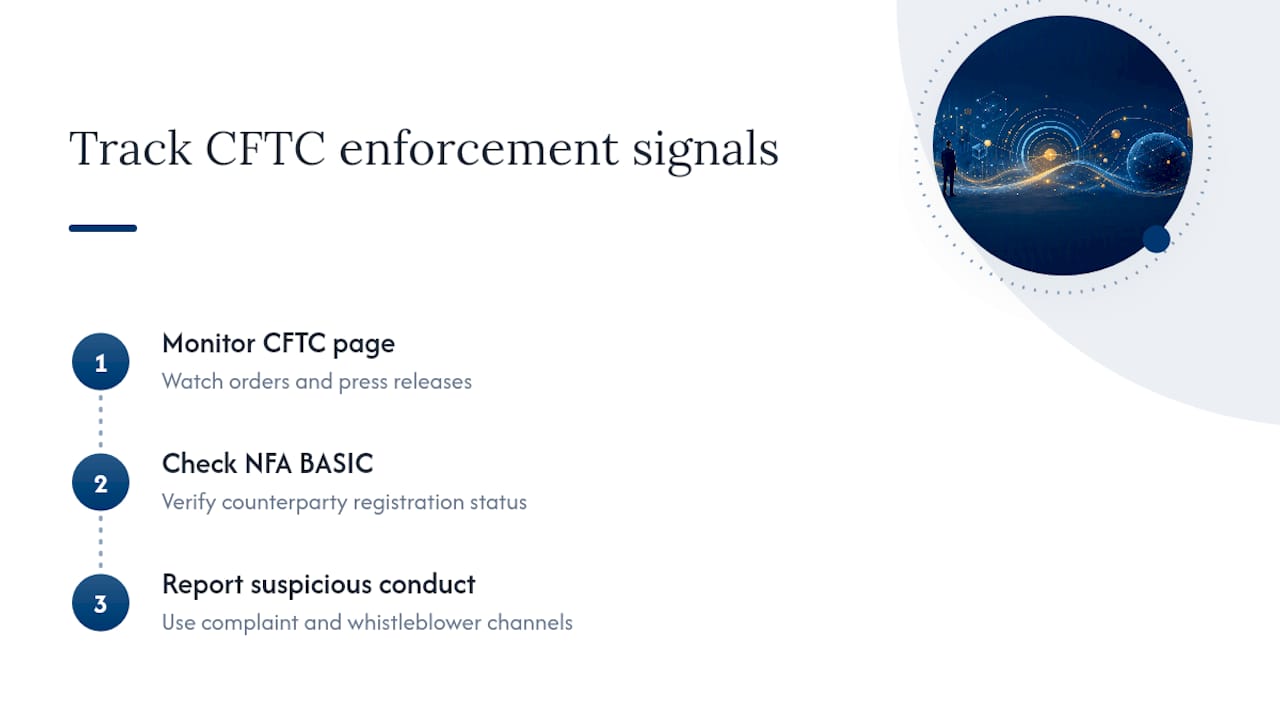
Watch the CFTC Enforcement Actions page for new orders and press releases, since the agency telegraphs priorities through its own case selection. Check counterparties and platforms against NFA BASIC before doing business with them, since registration status changes and a lapsed registration is itself a warning sign. If you spot suspicious conduct, the CFTC’s complaint and whistleblower channels, linked from the same enforcement page, exist specifically for that purpose.
Murphy’s Law: A Practitioner’s Evidence Checklist
Enforcement exposure maps cleanly onto three buckets: registration status, product classification, and customer-protection infrastructure. What separates a defensible position from a costly one is evidence quality, not policy language.
The documents that move a CFTC case are rarely the written compliance manual. They’re the IP geolocation logs, the account-linkage traces, the exception reports flagging blocked transactions in real time, and the smart contract governance records showing who controlled what and when. A remediation timeline with contemporaneous timestamps does more to reduce a penalty than any policy rewritten after the fact.
Firms that preserve this evidence early, rather than reconstructing it under subpoena pressure, consistently negotiate better outcomes.
When to Call Counsel: An Editorial Take
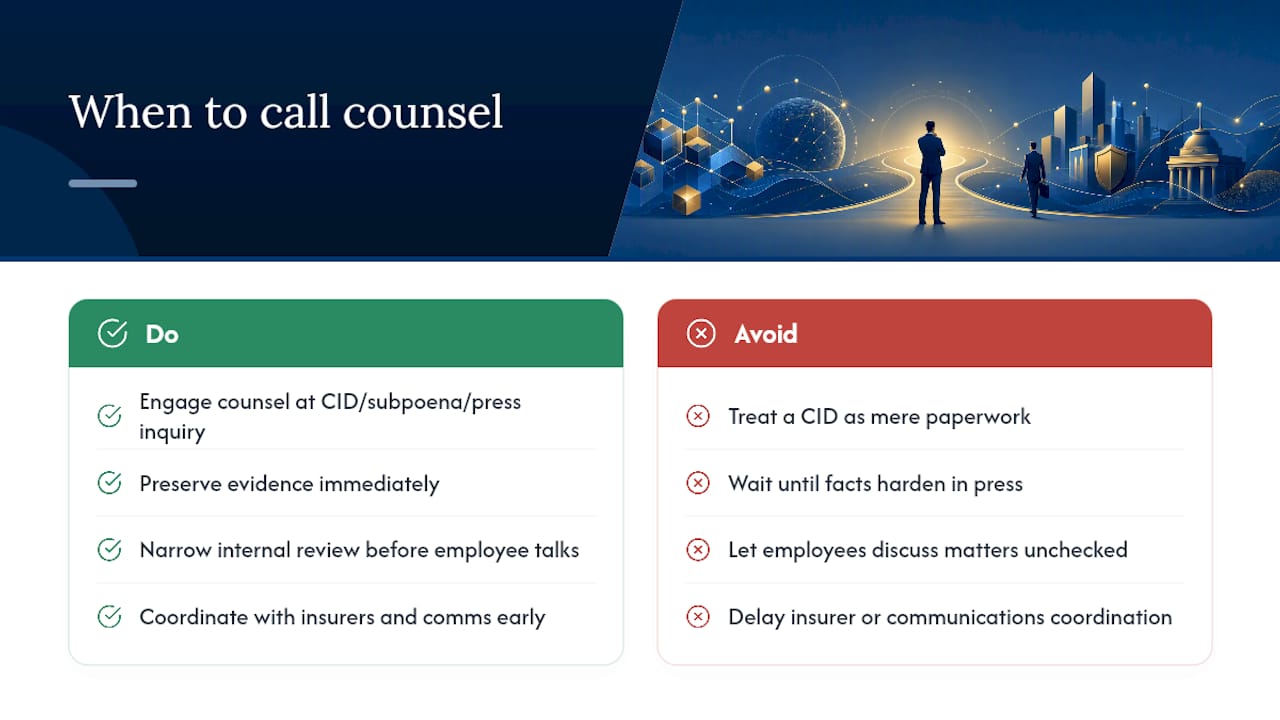
Most firms wait too long to bring in outside counsel, treating a Civil Investigative Demand as a paperwork exercise rather than the inflection point it actually is. The moment a CID, subpoena, major customer harm event, or press inquiry lands, the clock on evidence preservation starts running whether you engage a lawyer or not.
Early counsel does three things well: it narrows the internal review before employees start talking to each other in ways that create new liability, it coordinates with insurers and communications teams before a story hardens in the press, and it identifies voluntary remediation steps that regulators actually credit. Waiting rarely buys anything except a worse starting position.
— Mark
Get Legal Help With CFTC Enforcement or Crypto Fraud Recovery
There are licensed crypto law firms that provide legal services distinct from unregulated “recovery services” that charge upfront fees and disappear. Some lawyers have litigated matters involving major crypto cases, and law firms may handle defense of businesses facing CFTC scrutiny as well as recovery of stolen funds for fraud victims.
If your business needs a compliance program built to withstand registration, KYC/CIP, and product-design scrutiny, Some firms offer crypto compliance consulting under various fee arrangements. If a CID or subpoena is received, engaging early counsel can influence inquiry outcomes more effectively than post-hoc defense strategies. And if you’ve lost funds to crypto fraud, Some firms have recovery litigation teams that pursue asset tracing and civil claims on contingency. Schedule an intake consultation to find out which path fits your situation.
Primary Sources Worth Reading Directly
- CFTC Enforcement Actions page
- Ian McGinley’s remarks on crypto enforcement trends
- KuCoin complaint
- Deridex order
- March 2026 joint SEC-CFTC interpretation, Release 9198-26
- May 2026 Policy Statement on Perpetual Contracts
For a comparison of how CFTC authority interacts with SEC jurisdiction, see SEC vs CFTC crypto rules. Firms weighing intermediary and copy-trading models may also find this analysis of compliant copy trading structures useful context.
This article is general information, not a substitute for advice from a qualified lawyer. Consult a qualified legal professional about your own circumstances before acting on anything here.
Sources
- Enforcement Actions | CFTC
- Remarks of Enforcement Director Ian McGinley: ‘Trends in the CFTC’s Recent Crypto Enforcement Actions’
- CFTC Joins SEC to Clarify the Application of Federal Securities Laws to Crypto Assets (Release Number 9198-26)
- Order instituting proceedings and matters regarding Deridex (CFTC)
FAQ
Does the CFTC regulate crypto?
Yes, when a digital asset functions as a commodity derivative or involves off-exchange commodity transactions, the CFTC has jurisdiction under the Commodity Exchange Act regardless of where the platform is incorporated.
How many states has the CFTC sued?
The CFTC operates as a federal agency and brings cases in federal court rather than suing states; its enforcement actions target companies and individuals nationwide and internationally wherever U.S. persons are affected.
What is the current status of crypto legislation in the US?
Comprehensive federal crypto legislation remains unsettled, but the CFTC and SEC have moved toward coordinated administration of existing law, evidenced by their March 2026 joint interpretation clarifying how securities and commodity frameworks apply to digital assets.
Which brokers are recognized by the CFTC in the US?
Recognized brokers include registered futures commission merchants, swap dealers, and other entities listed in NFA BASIC; verifying a broker’s registration status there before trading is the surest way to confirm CFTC recognition.
What should a crypto business do if it receives a CFTC subpoena?
Preserve all relevant records immediately, limit internal discussion of the matter, and bring in regulatory counsel before responding, since early legal involvement shapes both the scope of the inquiry and any eventual penalty.