
Crypto insurance coverage exists, but it splits sharply along one line: institutional buyers can purchase serious protection, while retail investors mostly cannot. Custodians, exchanges, and mining operations can buy crime, custody, and cyber policies from Lloyd’s-backed underwriters with headline limits in the hundreds of millions. Retail investors are largely limited to niche insurers, wallet-protection partnerships, and on-chain mutuals, and rarely hold a direct claim against the big institutional policies backing the platform they use.
TL;DR:
- Institutional crypto insurance policies offer headline limits in the hundreds of millions, but retail options are limited to niche insurers and on-chain pools.
- Coverage exclusions include market depreciation and self-custody losses, with institutional policies only covering well-controlled custody setups.
- Retail investors should verify whose name is on the policy and recognize that exchange-held assets rarely offer direct protection for individual accounts.
- Underwriting depends heavily on custody architecture and operational controls, emphasizing multi-factor authentication, cold storage, and independent audits.
- Legal action and timely forensic investigation are crucial, as insurance claims often require cooperation and pursue recovery efforts beyond payout limits.
Table of Contents
- What Types of Crypto Insurance Coverage Exist?
- Who Is Actually Covered, and Where’s the Retail Gap?
- How Does Underwriting Work for Crypto Insurance?
- Which Providers Actually Serve U.S. Buyers?
- How Do You Choose the Right Crypto Insurance Policy?
- When Insurance Isn’t Enough: The Legal Layer
- Bottom Line for U.S. Readers
- Why This Guide Takes a Different Approach
- How Murphy’s Law Supports Recovery When Insurance Falls Short
- Sources
- FAQ
What Types of Crypto Insurance Coverage Exist?
Crypto insurance breaks into distinct policy classes, each built for a different failure mode. Understanding which one covers which loss matters more than shopping by price.
- Custody and cold storage coverage protects against physical loss, theft, or damage to devices holding private keys, plus losses during transit between vaults.
- Hot wallet and exchange crime/cyber coverage responds to external hacking, employee dishonesty, and platform-level compromise of internet-connected wallets.
- Directors and officers (D&O) and errors and omissions (E&O) coverage protects leadership and operational teams against liability claims tied to management decisions or service failures.
- Smart-contract and DeFi coverage pays out when a protocol exploit or bug drains funds, though scope varies widely by underwriter.
- Staking and slashing coverage addresses validator penalties from downtime or misbehavior, a niche but growing category as institutional staking expands.
Every one of these policies carries hard exclusions. Market depreciation is never covered. Neither is a self-custody user losing their own private keys. Evertas and other specialist crypto insurers write custody and crime policies with per-policy limits reported as high as hundreds of millions of dollars, but that scale is reserved for institutional-grade custody setups, not a personal hardware wallet.
Who Is Actually Covered, and Where’s the Retail Gap?
Insurance policies name a specific policyholder, called the named insured, and that single fact explains most retail confusion. When an exchange buys a crime policy, the exchange is the named insured, not the individual account holders. A payout goes to the platform, which then decides how to distribute funds, use internal reserves, or absorb the loss itself.
The Federal Trade Commission has warned that consumers frequently misread these arrangements, especially when platforms display “insured” badges that imply personal protection that doesn’t exist.
Retail users do have a few direct options, though:
- Breach Insurance’s Crypto Shield+ sells regulated policies directly to individuals holding assets at approved exchanges.
- Nexus Mutual lets retail DeFi users buy protocol and smart-contract cover on-chain, with claims paid from a member-funded pool.
- Wallet-protection partnerships bundle limited coverage into certain custody products.
If you see a badge claiming assets are “insured up to $X,” check whose name is on the policy before assuming it protects you.
How Does Underwriting Work for Crypto Insurance?
Underwriters price crypto risk almost entirely on custody design and operational controls. A firm using multi-party computation or deep cold storage with documented key-management procedures pays less and can access higher limits than one relying on hot-wallet balances alone. Lockton’s LEAP DAC facility treats custody model as the dominant driver of both price and insurability, not transaction volume.
Underwriters generally require:
- Multi-factor authentication and documented segregation of duties across key personnel.
- Proof of cold-storage procedures, including key-generation ceremonies and access logs.
- Independent audits: SOC 2 reports, penetration testing, and smart-contract audits where relevant.
- Named-peril definitions that specify exactly which events trigger a payout, not a blanket “any loss” promise.
Policy language matters as much as the limit itself. Watch for sub-limits within a broader policy, valuation clauses that fix asset value at the time of loss rather than time of claim, and waiting periods before coverage activates.
Pro Tip: Ask your broker for the exact named-peril list in writing before binding a policy. “Theft” and “unauthorized transfer” can mean legally different things when a claim is disputed.
Which Providers Actually Serve U.S. Buyers?
The provider landscape splits cleanly by buyer type, and no single company serves every segment well. Institutional custodians shop Lloyd’s-backed specialists and broker facilities; retail investors and DeFi users have a narrower, but real, set of options.
| Provider | Best for | Coverage types | Typical headline limits | U.S. availability | Notable exclusions |
|---|---|---|---|---|---|
| Evertas | Institutional custodians, exchanges, mining operators | Custody, crime, mining risk | Up to hundreds of millions per policy | Institutional | Market loss, uninsured custody practices |
| Lockton (LEAP DAC) | Institutions seeking brokered London-market access | Custody indemnity for private-key loss/theft | Facility-based, scales to client need | Institutional | Losses outside defined custody controls |
| Breach Insurance (Crypto Shield+) | Retail investors on approved exchanges | Theft, unauthorized transfer | Retail policy limits, individually underwritten | Retail | Exchange mismanagement, market depreciation |
| Nexus Mutual | DeFi users seeking smart-contract cover | Protocol and smart-contract exploit cover | Member-pool dependent | Retail (on-chain, direct) | Non-covered protocols, governance-excluded events |
| Canopius | Institutional and specialty crypto risk | Crime, custody, specialty lines | Varies by program | Institutional | Standard market exclusions apply |
Exchanges themselves add another layer. Coinbase, Gemini, and Crypto.com maintain internal security programs and, in some cases, partial insurance on hot-wallet holdings, but these protections belong to the platform, not the account holder. Binance’s SAFU fund and similar self-funded reserves work the same way: a corporate safety net, not a personal insurance policy. BitGo, as a qualified custodian, carries its own institutional crime and custody coverage that supports the assets it holds on behalf of clients. None of these functions as a substitute for a direct policy in your own name.
How Do You Choose the Right Crypto Insurance Policy?
Evaluating a policy or provider comes down to a short list of hard questions, asked before you sign anything.
- Who is the named insured, and does that match who actually bears the loss if something goes wrong?
- What specific events trigger coverage, and how does the policy define “theft” versus “unauthorized transfer”?
- What is the valuation method for lost assets, at time of loss or time of claim?
- Are there sub-limits buried inside the headline number, and what waiting period applies before a claim can be filed?
- Can the insurer or broker show past claims examples and actual payout history, not just marketing limits?
Treat vague answers as a red flag. A primer on small-business cyber insurance makes a point that applies just as well here: policy wording, not the sticker limit, decides whether a real-world loss gets paid.
When Insurance Isn’t Enough: The Legal Layer
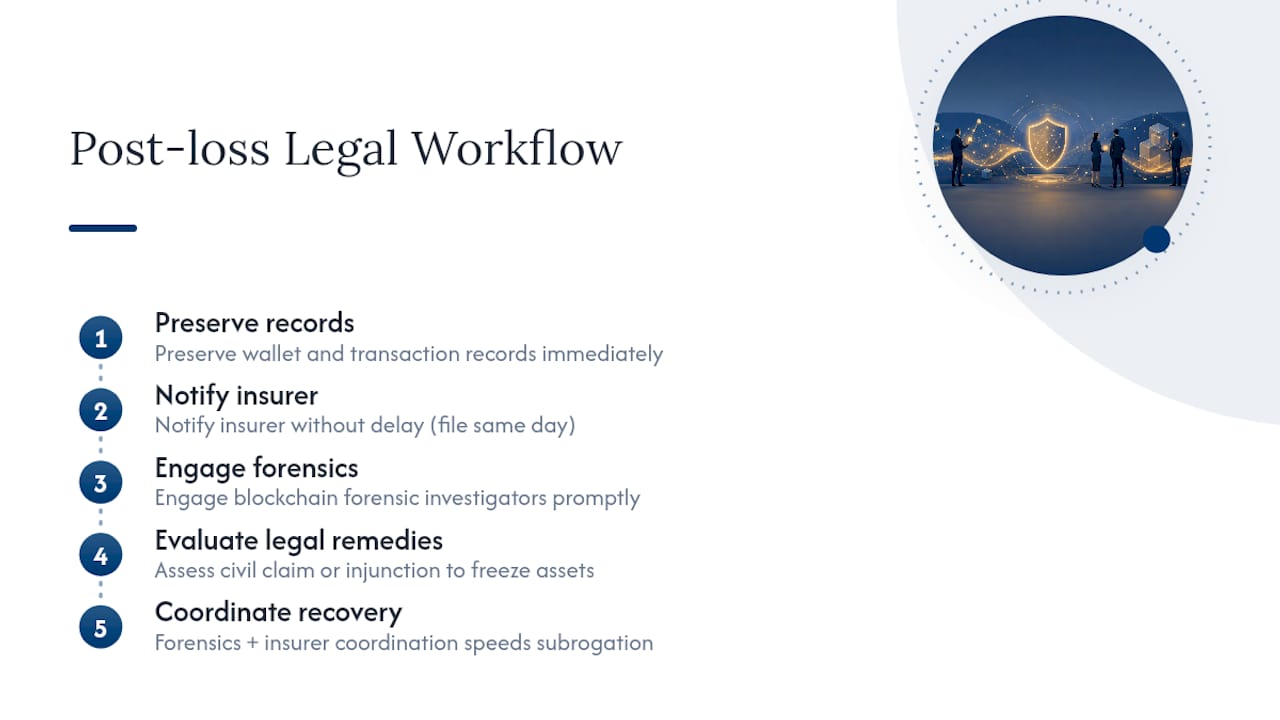
Insurance and litigation often run in parallel, not in sequence. Insurers frequently require policyholders to cooperate with forensic investigations, preserve transaction logs, and pursue recovery suits before or alongside a claim payout.
When insurers and platforms coordinate on a loss, timely forensics and preserved evidence directly speed up subrogation and recovery, and early legal counsel is often what makes that coordination work.
The practical workflow looks like this: preserve wallet and transaction records immediately, notify the insurer without delay, engage blockchain forensic investigators, and evaluate whether a civil claim or injunction can freeze stolen assets before they move further. Litigation involving platforms like Celsius and Terraform Labs has shown how forensic tracing and court action can recover funds insurance alone never touches.
Pro Tip: File your insurer notification and your evidence-preservation steps on the same day. Delayed notice is one of the most common reasons insurers deny otherwise valid claims.
Bottom Line for U.S. Readers
Institutional buyers, custodians, exchanges, and mining operations should pursue bespoke coverage through Lloyd’s-backed insurers like Evertas or broker facilities like Lockton’s LEAP DAC. Retail investors should look at Breach Insurance for exchange-held assets or Nexus Mutual for DeFi exposure, and treat any theft as a legal matter from day one, not just an insurance claim.
Why This Guide Takes a Different Approach
Most crypto insurance content either oversells retail protection or buries readers in institutional jargon they’ll never use. The honest picture sits between those extremes: real coverage exists, but it’s stratified by buyer type in a way most marketing copy glosses over.
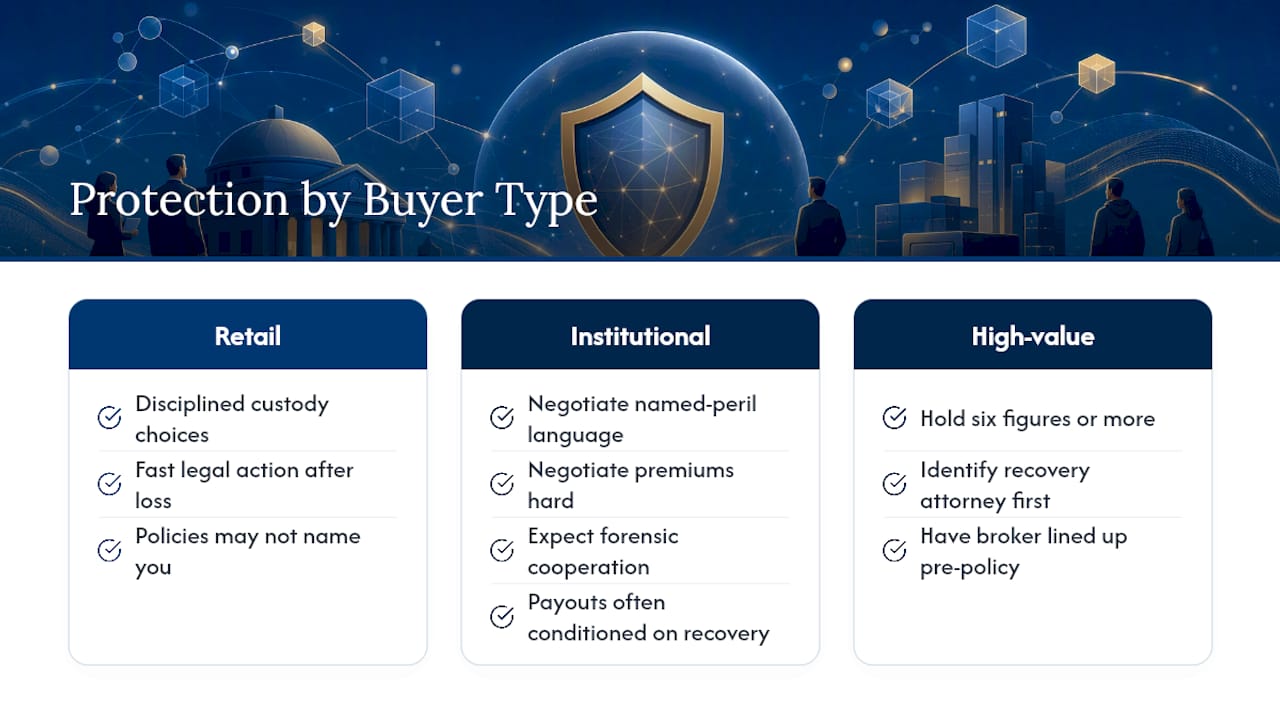
The bigger blind spot isn’t coverage availability, it’s timing. Readers fixate on finding the right policy and forget that insurers expect cooperation with forensic investigators and often condition payouts on pursuing recovery. Treating insurance and litigation as sequential, insurance first, lawyer later, costs victims real money and real time.
My honest read: retail investors get more protection from disciplined custody choices and fast legal action after a loss than from chasing a policy that may not name them as the insured anyway. Institutional buyers should negotiate named-peril language as hard as they negotiate premium. And anyone holding six figures or more in digital assets should have a recovery attorney identified before they ever need one, the same way they’d have a broker lined up before a policy lapses.
— Mark
How Murphy’s Law Supports Recovery When Insurance Falls Short
Legal support is available for investors and businesses who discover that an insurance claim alone won’t recover what they lost. When a policy excludes the loss, when the named insured isn’t you, or when an exchange simply won’t move fast enough, legal action fills that gap. Murphyslawcrypto handles blockchain forensic investigations, asset tracing, and crypto fraud recovery litigation for victims, and works directly with clients’ insurers and forensic teams to preserve evidence and support subrogation claims.
Legal advisers can also assist crypto businesses on regulatory defense and compliance programs, work that often overlaps with underwriting requirements insurers impose on custodians and exchanges. If you’ve suffered a crypto loss and aren’t sure whether insurance, litigation, or both apply to your case, start with a consultation on your legal options before evidence goes stale.
Where to Verify Coverage Details
- Evertas: institutional crypto insurer, headline limits and Lloyd’s market backing.
- Nexus Mutual: on-chain DeFi cover and claims history.
- NAIC cryptocurrency insurance topics: regulatory and consumer-protection guidance.
- Breach Insurance FAQ: retail eligibility rules and exclusions.
This article is general information, not a substitute for advice from a qualified financial advisor. Consult a qualified financial professional about your own circumstances before acting on anything here.
FAQ
Is There Any Insurance for Cryptocurrency?
Yes. Institutional insurers like Evertas and broker facilities like Lockton’s LEAP DAC cover custody and crime risk, while retail options include Breach Insurance’s Crypto Shield+ and Nexus Mutual’s on-chain DeFi cover.
Which Company Offers Cryptocurrency Insurance?
Evertas, Canopius, and Lloyd’s coverholders serve institutional buyers, while Breach Insurance and Nexus Mutual sell coverage directly to retail investors and DeFi users.
Can the IRS See Your Crypto Wallet?
The IRS can trace wallet activity through exchange reporting requirements and blockchain analysis tools, and transactions on public blockchains are generally traceable to identified wallets once linked to a regulated exchange account.
Which U.S. State Is Crypto-Friendly?
Wyoming and Texas are widely regarded as favorable for crypto businesses due to clearer digital asset statutes and custody frameworks, though regulatory obligations still apply nationally regardless of state of incorporation.
Does an Exchange’s “Insured” Badge Protect My Personal Holdings?
Usually not directly. The policy typically names the exchange as the insured party, and the platform decides whether and how to pass any payout to affected users.