
Most exchange account freezes are compliance or security holds, not confiscation. The exchange has flagged something in your identity verification, transaction history, or a third-party report and needs paperwork before releasing access. Your first move should always be to preserve every record of the freeze and submit the exact documents requested, in one complete package, before considering a formal complaint or legal counsel.
TL;DR:
- Most exchange account freezes result from compliance, security, or legal orders, not confiscation, and require submitting complete, labeled documentation to resolve.
- The typical freeze duration varies from 24-72 hours for security holds to 2-6 weeks for source-of-funds reviews, with law enforcement holds being indefinite.
- Properly identifying the freeze trigger category and providing an organized evidence package can significantly shorten resolution time.
- Escalating to consumer protection agencies or legal counsel becomes necessary if no progress occurs after 30 days of incomplete support responses.
- A licensed crypto law firm offers a more effective approach for high-value or prolonged freezes by directly engaging exchange legal teams and tracing blockchain assets.
Table of Contents
- Why Exchanges Freeze Accounts in the First Place
- Step-by-Step: What to Do Now to Unfreeze Your Account
- How Long Does an Account Freeze Really Last?
- When Support Stalls: Escalation and Legal Options
- Building Your Documents and Evidence Checklist
- Reducing the Risk of a Future Freeze
- What a Crypto Law Firm Actually Does When Your Funds Are Locked
- Sitting With a Freeze: How to Think While You Wait
- Getting Help From Murphy’s Law When an Exchange Won’t Budge
- Sources
- FAQ
Why Exchanges Freeze Accounts in the First Place
An exchange account freeze almost always traces back to one of five triggers, and knowing which one applies to you determines how fast it resolves and what evidence actually moves the needle.
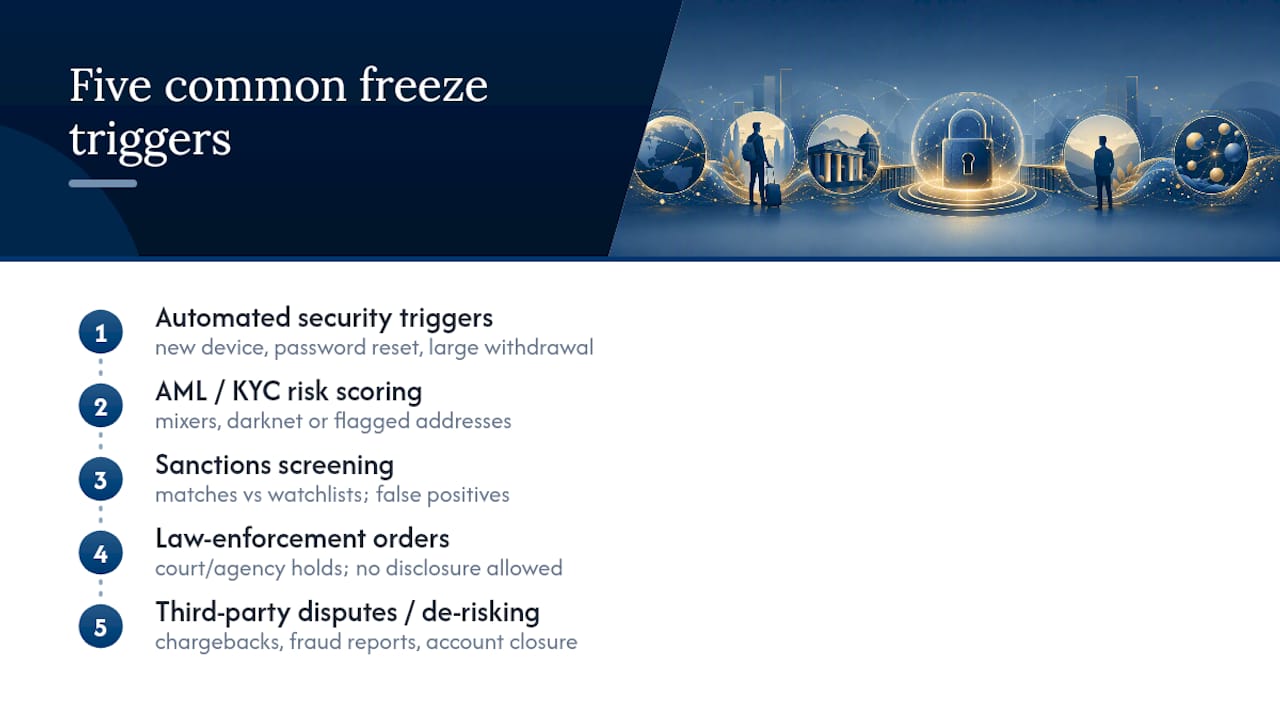
Automated security triggers fire the fastest and clear the fastest. A new device login, a password reset, or an unusually large withdrawal request can trip a fraud filter within seconds. These holds are usually short, often resolved once you confirm identity through a follow-up verification step.
AML and KYC risk scoring is the category most crypto account frozen complaints fall into. Exchanges in the United States operate under obligations similar to banks, requiring identity verification and ongoing transaction monitoring under FinCEN-style compliance frameworks. If your wallet has touched a mixer, a darknet-linked address, or a flagged exchange, chain-analytics software assigns a risk score that can trigger a hold even when you did nothing wrong.
Sanctions screening compares your name, address, and connected wallets against watchlists. False positives happen more than most users expect, particularly with common names or wallets that received even a small, indirect transfer from a sanctioned address several hops back.
Law-enforcement orders are the least negotiable. When a court or agency directs an exchange to hold funds tied to an investigation, the exchange typically cannot disclose case details. This is also where the confusing “we can’t tell you why” response often stems from a real legal duty, not poor customer service, since no-tipping-off rules tied to suspicious-activity reports restrict what staff can say.
Third-party disputes and de-risking round out the list. A counterparty chargeback claim, a fraud report filed by someone else, or a business decision to simply de-risk your account type can all result in a freeze or outright closure, independent of anything you did.
Recognizing which category fits your situation tells you what to send and roughly how long to wait before escalating.
Step-by-Step: What to Do Now to Unfreeze Your Account
Account suspension issues rarely resolve through panic or repeated support tickets. They resolve through a clean, complete submission the first time.
-
Preserve everything immediately. Screenshot the freeze notice, save ticket numbers, timestamps, and any email correspondence. Note the exact wording of the notice, since “security review,” “compliance review,” and “pending investigation” point to different processes and different timelines.
-
Identify the trigger category. Match the notice language to one of the five triggers above. This determines which documents matter most.
-
Assemble a complete evidence package. Include government-issued ID, proof of address, recent bank statements, exchange transaction export reports, and annotated wallet transaction IDs that map incoming funds to a documented source. If ownership of a wallet is in question, a signed message proving control can help.
-
Submit once, completely. Compliance teams process an automated screen, then a manual review, then a document request, then a decision. Submitting a full, correctly labeled source-of-funds package on the first attempt consistently shortens the number of back-and-forth cycles, each of which can add days or weeks. Uploading partial documents piecemeal restarts that clock.
-
Escalate if you hear nothing. If the compliance team goes silent for an extended stretch, file a formal written appeal through the exchange’s dispute channel, then move to external escalation.
Pro Tip: Name your files clearly before uploading. “Bank_Statement_March2026_JohnSmith.pdf” gets processed faster than “scan001.pdf” because the reviewer isn’t guessing what they’re looking at.
If internal escalation stalls, U.S.-facing platforms are subject to CFPB complaint procedures, and state attorney general offices accept consumer complaints against financial platforms operating in their jurisdiction. Both create a documented record that outlasts a single support thread.
How Long Does an Account Freeze Really Last?
Timelines vary sharply by trigger, and understanding the range helps you judge when patience is reasonable and when it isn’t.
- Security holds: typically 24 to 72 hours once identity is reconfirmed.
- Sanctions or deposit-risk flags: often days to three weeks, depending on how quickly a false positive can be cleared.
- Source-of-funds reviews: commonly 2 to 6 weeks, since compliance officers manually trace the money.
- Law-enforcement holds: indeterminate. The exchange cannot act until the order is lifted.
Resolution windows for these five freeze categories differ materially, which is why a “just wait it out” mindset only works for some of them.
If 30 days pass with no substantive update beyond automated replies, that’s a reasonable trigger point for formal escalation. Outcomes generally land in one of four places: full clearance, restricted withdrawal-only access, account closure with a limited withdrawal window, or in rare cases involving law enforcement, an extended legal hold. A complete, well-organized evidence packet submitted early tends to push cases toward the faster outcomes.
When Support Stalls: Escalation and Legal Options
Once internal appeals go nowhere, the path forward runs through consumer channels first, then legal channels if the amount and circumstances justify it.
Start with a formal written complaint to the exchange, referencing prior ticket numbers, to create a paper trail distinct from casual support chat. From there:
- CFPB complaint (for U.S.-facing platforms): typically forces a company response within roughly 15 days, which routes your case past front-line support entirely.
- State attorney general complaint: runs in parallel and adds regulatory pressure, particularly effective when multiple consumers report the same pattern.
- Better Business Bureau complaint: lower leverage but adds a public record.
- Arbitration or small claims: appropriate for smaller disputed amounts, though many exchange user agreements route disputes into arbitration by default, which limits your ability to sue directly.
Hiring a crypto-specialist law firm makes sense once the frozen amount is substantial, the case has stalled for weeks despite a complete submission, or forensic tracing is needed to prove fund provenance. Licensed counsel with courtroom experience can package evidence and communicate directly with exchange compliance teams, which frequently moves faster than another support ticket. Legal engagement typically comes with tradeoffs, though: arbitration clauses in most exchange terms of service can limit available remedies, and court filings or injunctions are reserved for narrow, high-stakes situations rather than routine holds. If you’re pursuing recovery after outright fraud rather than a compliance freeze, the process and available remedies differ, and this step-by-step legal guide walks through that distinction.
Pro Tip: A legal-first escalation, where counsel submits the evidence packet directly to the exchange’s legal team rather than support, often outperforms repeated tickets for high-value freezes because it reaches someone with actual authority to act.
Building Your Documents and Evidence Checklist
A well-constructed evidence packet is the single biggest lever you control. Compliance reviewers prefer clearly labeled, internally consistent documents, and gaps or mismatched names between your ID and your bank statement repeatedly slow reviews down.
| Document Type | What to Include | Formatting Tip |
|---|---|---|
| Identity verification | Government ID, proof of address | Name must match exactly across all documents |
| Proof of funds | Bank statements, receipts, invoices, OTC/P2P confirmations | PDF exports over screenshots when possible |
| Blockchain evidence | Transaction IDs, annotated wallet flow, signed ownership message | Map each incoming transaction to a documented source |
| Support history | Ticket numbers, dates, exact notice wording | Chronological order, one PDF |
Consistent KYC documentation also strengthens any later fraud claim if the freeze turns out to involve a scam rather than a routine compliance check.
Reducing the Risk of a Future Freeze
Prevention costs almost nothing compared to the weeks lost fighting a hold after the fact.
- Keep dated records of every fiat on-ramp, OTC trade, and P2P transaction as it happens, not months later.
- Use consistent KYC details across every platform, since mismatched names or addresses raise automatic flags.
- Enable two-factor authentication and avoid logging in from shared or unfamiliar devices.
- Steer clear of mixers, high-risk P2P counterparties, and services with weak or absent compliance programs.
- Space out large deposits rather than making irregular, unexplained lump-sum transfers that resemble structuring patterns.
Pro Tip: If you’re moving significant value into self-custody, weigh the tradeoff honestly: you gain control over freezes but lose the ability to reverse mistakes or recover from lost keys. Neither option eliminates risk; they just relocate it.
What a Crypto Law Firm Actually Does When Your Funds Are Locked
A licensed crypto law firm founded by an experienced attorney provides legal services in crypto litigation, including cases involving Celsius, Terraform Labs, and BitMEX.
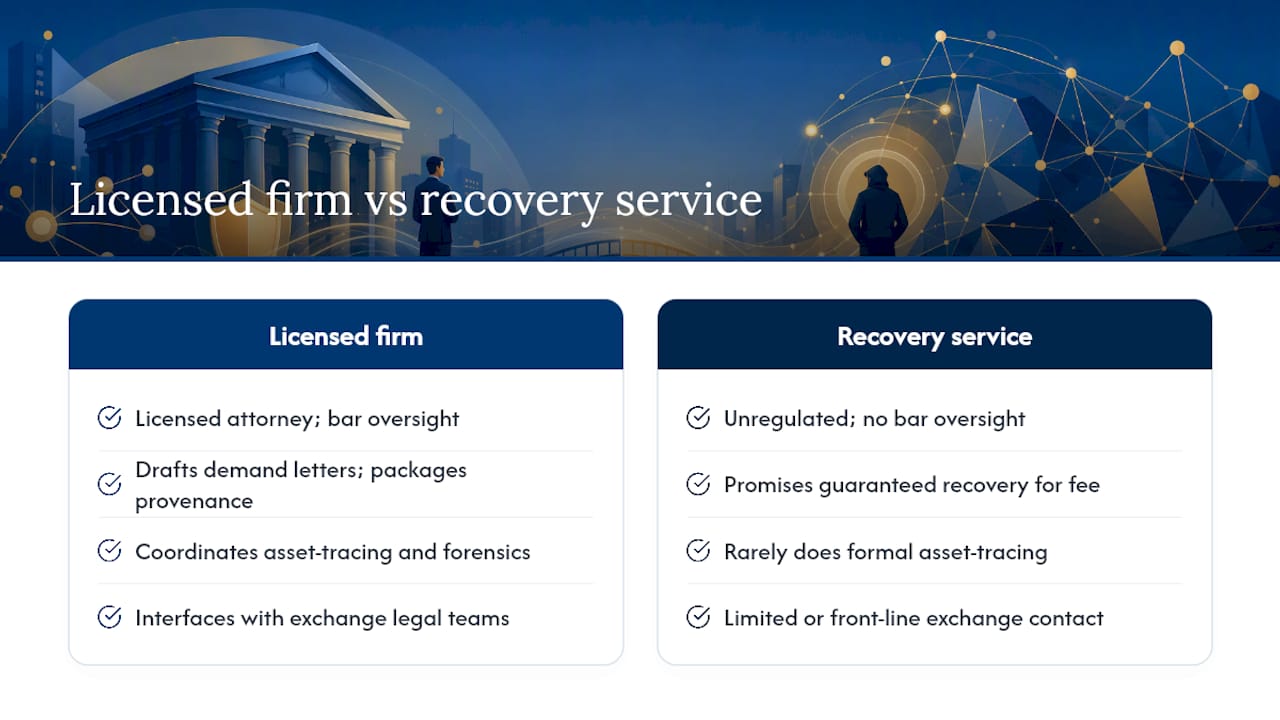
Legal counsel handling a frozen account typically drafts formal demand letters, packages provenance evidence into a format compliance teams can act on quickly, coordinates asset-tracing when blockchain forensics are needed, and interfaces directly with an exchange’s legal department rather than front-line support. In law-enforcement cases, counsel can request confirmation of a holding order’s existence while preserving civil options, even when the exchange itself cannot disclose case details.
Unregulated “crypto recovery services” often promise guaranteed fund retrieval for an upfront fee and disappear once paid. A licensed law firm operates under bar rules, courtroom accountability, and real litigation exposure, which is the core difference victims should verify before hiring anyone.
Sitting With a Freeze: How to Think While You Wait
A frozen account feels personal. It usually isn’t. Compliance systems respond to paperwork and escalation timelines, not intent or urgency, so the fastest path forward is treating the freeze like a workflow problem rather than a grievance.
Document everything as it happens. Submit one complete package rather than trickling in documents over several attempts. If 30 days pass with no substantive movement, or if the frozen amount is large enough that a delay carries real financial consequences, that’s the point to consider a formal complaint or a conversation with counsel rather than another support ticket.
— Mark
Getting Help From Murphy’s Law When an Exchange Won’t Budge
If your compliance appeal has stalled and the frozen amount is significant, a specialized crypto law firm can offer a faster path than cycling through support tickets on your own. Such firms handle fraud recovery litigation, direct compliance communications with exchange legal teams, and blockchain-based asset tracing, the same document-packaging work that consistently moves stalled cases forward.
Before reaching out, gather your evidence packet: ID, proof of funds, transaction exports, and every piece of correspondence with the exchange’s support and compliance teams. Having that ready lets the firm assess your case quickly rather than starting from scratch. If you’re dealing with a frozen account tied to a broader fraud situation, or a compliance review that has quietly turned into a dead end, start with the firm’s crypto fraud recovery services page to see what a legal review of your case would involve.
This article is general information, not a substitute for advice from a qualified lawyer. Consult a qualified legal professional about your own circumstances before acting on anything here.
Sources
- Cryptocurrency in the Americas — Financial Crime Academy
- Crypto Exchange Account Frozen? What to do if you cannot access your cryptoasset exchange accounts — Lexology
- Agencies clarify banks may contact customers tied to SARs — American Banker
- Why Do Crypto Exchanges Freeze Accounts? AML Explained — LeoDex
FAQ
How Do I Fix My Frozen Exchange Account?
Save every notice and message, identify whether it’s a security, compliance, or law-enforcement hold, then submit one complete evidence package including ID, proof of funds, and transaction records through the exchange’s compliance channel.
How Can I Unfreeze a Frozen Crypto Account?
Submit a full source-of-funds package on your first attempt rather than partial uploads, since each incomplete submission restarts the review cycle and adds days or weeks to the timeline.
Can I Still Receive Money if My Account Is Frozen?
Most freezes restrict withdrawals, not incoming deposits, but this varies by exchange and by the specific type of hold, so check your account notice for the exact restrictions listed.
When Should I Contact a Lawyer About a Frozen Exchange Account?
Consider legal counsel once 30 days have passed with no substantive response despite a complete document submission, or when the frozen amount is large enough that forensic tracing or direct communication with exchange counsel could meaningfully speed resolution.
What’s the Difference Between a Crypto Freeze and a Stock or Forex Account Freeze?
Crypto freezes usually center on blockchain-based risk scoring and AML rules unique to digital assets, while stock and forex account restrictions more often stem from margin calls, regulatory holds tied to securities law, or pattern-day-trading rules, each governed by different regulators and appeal processes.