
Letters rogatory are the correct tool when a U.S. civil crypto case needs evidence or testimony sitting inside a foreign court’s jurisdiction and no faster treaty channel applies. They work through diplomatic or central-authority transmission rather than direct subpoena, which makes them reliable but slow, often taking months rather than weeks. Civil litigants and crypto fraud victims should treat letters rogatory as a fallback tool, not a first move, and understand the procedural checklist before filing.
TL;DR:
- Letters rogatory are a slow, diplomatic tool mainly suitable when no faster treaty or central authority route exists for crypto evidence.
- Crafting a precise, signed request with detailed transaction data and certified translation can speed foreign court processing and reduce rejection risk.
- Most exchanges now process legal requests through compliance portals like Kodex, often within about 30 days, but timing still varies significantly by country.
- Expect several months for the entire process, with delays caused by translation, legalization, or court backlog, and costs covering legal, translation, and transmission fees.
- Avoid sending broad, vague requests or through incorrect channels, and always confirm exchange procedures beforehand to improve chances of timely cooperation.
Table of Contents
- When Are Letters Rogatory Appropriate in Crypto Cases?
- How Do You Draft and Transmit a Letter Rogatory for Crypto Evidence?
- How Do Crypto Exchanges Respond to International Legal Requests?
- How Long Does a Letter Rogatory Take, and What Does It Cost?
- Why Do Letters Rogatory Get Rejected, and How Do You Avoid It?
- How Murphy’s Law Combines TROs, Tracing, and Rogatory Requests
- What the Guidance Gets Wrong
- How Murphy’s Law Handles Cross-Border Crypto Evidence Requests
- Where to Go for Primary Guidance
- Sources
- FAQ
When Are Letters Rogatory Appropriate in Crypto Cases?
A letter rogatory is a formal request from a U.S. court to a foreign court, asking that court to compel evidence, testimony, or judicial cooperation on the requesting court’s behalf. That is fundamentally different from mutual legal assistance, which flows through treaty-based MLAT channels reserved for criminal prosecutors. Civil litigants who try to piggyback on a criminal MLA request typically see it rejected outright, since those channels exist for government-to-government criminal cooperation, not private lawsuits.
In crypto litigation, letters rogatory tend to fit a narrow set of situations:
- Records held by a foreign-domiciled exchange with no U.S. presence or cooperative legal portal.
- Custodial wallet data controlled by an offshore custodian outside voluntary compliance reach.
- Testimony from a witness who resides abroad and won’t appear voluntarily.
- Third-party custodians (foreign banks, payment processors) holding transaction logs tied to the fraud.
Skip letters rogatory when a faster MLAT or central-authority route exists, when the target has a U.S. affiliate that can be served domestically, or when the exchange will accept a certified civil request through its own legal portal. Check the civil versus criminal distinction in your case before spending months on transmission.
How Do You Draft and Transmit a Letter Rogatory for Crypto Evidence?
The request needs to be signed by the presiding judge, not just counsel, and it must be specific enough that a foreign court can execute it without guessing at intent. Vague language is the single biggest reason these requests stall.
A well-drafted letter rogatory for a crypto case typically includes:
- Case caption and procedural posture — the U.S. court, docket number, and a short statement of the underlying claim.
- Precise identification of items sought — exact wallet addresses, exchange account identifiers, date ranges, and transaction IDs rather than broad categories like “all records.”
- Witness identification — full name, last known address, and the specific testimony sought if a deposition is requested.
- Authentication and legalization — apostille or consular legalization depending on whether the destination country is a Hague Apostille Convention member.
- Certified translation — done by a translator who can attest to accuracy in the destination country’s language; courts routinely reject uncertified translations.
- Transmission routing — diplomatic channel through the U.S. State Department or, where available, a country’s central authority, which the State Department’s own preparation guidance walks through step by step.
Attach technical exhibits that do the persuading for you: a mapped transaction chain, timestamped CSV exports, and a forensic summary tying specific wallet addresses to the fraud allegations. Foreign courts and exchange legal teams respond faster to a request that already shows its work.
Pro Tip: Build your wallet-address-to-transaction map before you draft the letter, not after. Courts and exchanges both process a request faster when the technical exhibit already answers “why do you need this specific data.”
How Do Crypto Exchanges Respond to International Legal Requests?
Most major exchanges no longer accept legal requests by email or fax. They route them through standardized compliance portals built specifically to verify legitimacy and manage volume, and Kodex has become the dominant example across the industry. Crypto.com, for instance, directs law enforcement and legal requesters to its Kodex-managed channel and states it typically acknowledges and aims to respond within about 30 days once a request is properly submitted, though jurisdictional rules can still require MLAT procedures depending on where the requester and the data sit.
That last point matters for civil litigants. Some exchanges will accept an authenticated civil letter rogatory or certified copy directly. Others will bounce you to a central-authority process regardless of what channel you use, particularly when personal data protections in the exchange’s home jurisdiction require it. Confirm which category your target falls into before committing months to full diplomatic transmission.
Format requests the way exchange compliance teams actually process data:
- Request timestamped exports tied to specific wallet addresses, not open-ended account histories.
- Include internal trade or transaction IDs when you have them from prior discovery or a blockchain investigation.
- Loop in forensic analysts early so the technical ask matches how the exchange’s ledger is actually structured.
Pro Tip: Ask foreign counsel to confirm the exchange’s preferred channel before you file. A request routed correctly the first time often beats one that has to be resubmitted after rejection.
How Long Does a Letter Rogatory Take, and What Does It Cost?
Timelines vary enormously by destination country, but expect a normal request to run several months from drafting to execution, and longer where court backlogs or central-authority triage queues add delay. Translation delays and inconsistent legalization requirements are the most common bottlenecks, not the substance of the request itself.
Budget for these cost components:
- Foreign counsel retained to shepherd the request through the receiving court.
- Certified translation of the letter and every exhibit.
- Consular legalization or apostille fees.
- Forensic analyst time to prepare transaction mapping and wallet exhibits.
- Courier and authentication costs for physical transmission where required.
Letters rogatory are slower and less predictable than MLAT channels precisely because they lack a treaty framework forcing a response deadline. When speed matters more than formality, a preservation letter, a domestic TRO, or a direct exchange portal request will usually move faster and can run in parallel while the rogatory request works through the system.
Why Do Letters Rogatory Get Rejected, and How Do You Avoid It?
Foreign courts reject far more of these requests than U.S. litigators expect, and the reasons are consistent enough to build a checklist around.
- Overbreadth. A request for “all account records” reads as a fishing expedition. Narrow it to specific wallets, date ranges, and transaction identifiers.
- Weak nexus to the case. The request must tie clearly to a live claim; courts want to see why this specific evidence matters to this specific lawsuit.
- Wrong transmission channel. Sending through diplomatic channels when a central authority exists (or vice versa) can cause outright rejection rather than a redirect.
- Missing authentication or translation. An uncertified translation or an unlegalized signature page is an easy denial.
- Sovereignty and privacy objections. Some countries will refuse based on data protection law or public policy grounds; offering redacted copies, remote video testimony, or certified summaries in advance can preempt the objection.
Before filing, run through a short checklist: confirm the receiving country’s authentication requirements, verify translation certification standards, confirm the correct routing channel, and narrow every request to specific, identifiable items.
How Murphy’s Law Combines TROs, Tracing, and Rogatory Requests
Timing decides whether a letter rogatory produces usable evidence or arrives after the funds have moved. Firms handling crypto recovery cases often file a domestic temporary restraining order before initiating the international request, freezing what can be frozen while the rogatory works through a foreign court’s queue.
Formatted forensic deliverables do more persuading than legal argument alone. A clear wallet-address map, paired with a preliminary injunction where domestic assets are reachable, gives exchanges and foreign courts a concrete basis to act rather than a narrative to interpret.
Where a case presents parallel criminal exposure, coordination with U.S. authorities matters, but civil counsel must resist the temptation to lean on criminal MLA channels that aren’t theirs to use.
Before international steps begin, clients should have ready:
- Every wallet address and transaction hash tied to the loss.
- Exchange account details, including KYC records where available.
- Screenshots or logs of communications with the alleged fraudster.
- A timeline of transfers, with dates and amounts.
What the Guidance Gets Wrong
Most letters-rogatory guidance treats the process as a paperwork exercise: fill in the caption, get it authenticated, send it off. That framing undersells how much the outcome depends on what happens before the letter is even drafted.
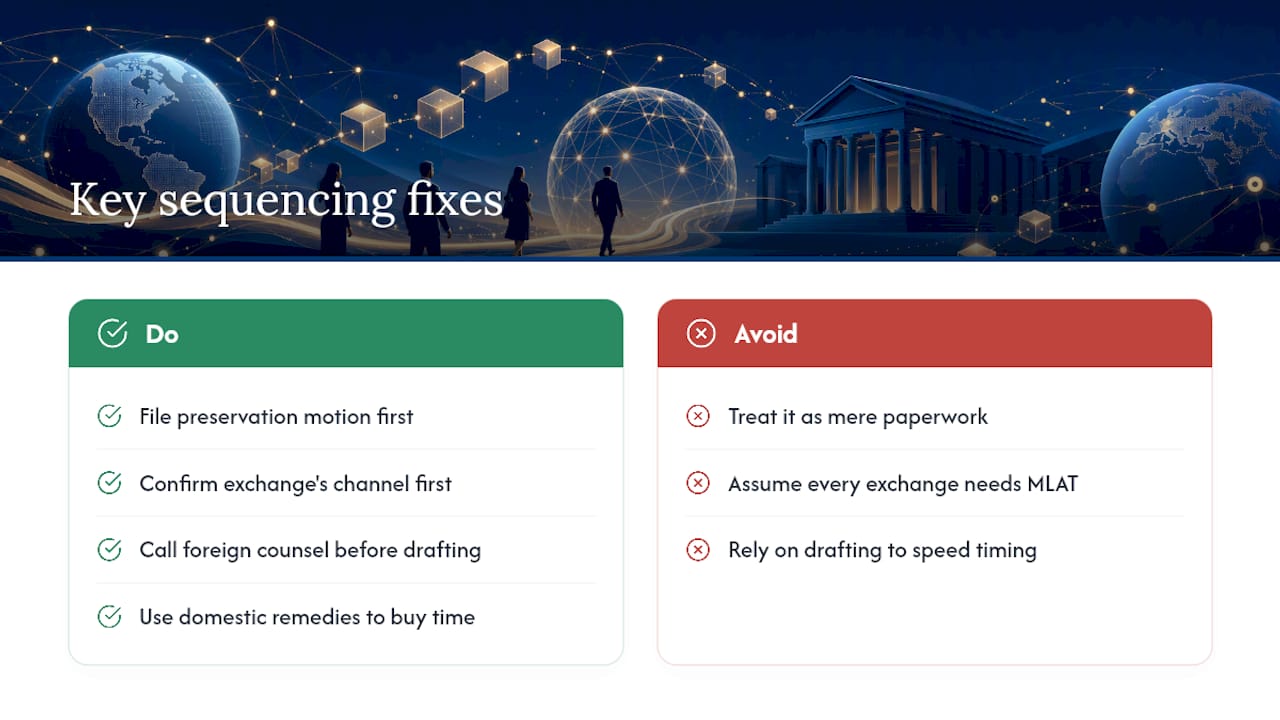
The real leverage point is sequencing. A letter rogatory filed without a preceding preservation motion is a request aimed at assets that may no longer exist by the time a foreign court gets around to executing it. The research on MLA and letters-rogatory timelines makes clear these requests are inherently slow and unpredictable, and no amount of careful drafting changes that physics. What changes the outcome is pairing the request with domestic remedies that buy time.
The second overlooked point: exchanges are not monolithic. Treating every exchange like it will demand full MLAT process, or assuming every exchange will accept a civil letter rogatory, wastes months. Confirm the specific exchange’s channel first. That single phone call to foreign counsel, made before drafting begins, probably saves more time than any clause in the letter itself.
— Mark
How Murphy’s Law Handles Cross-Border Crypto Evidence Requests
Murphy’s Law is the alternative to hiring a general litigation firm for crypto cases that cross borders: a licensed law firm built specifically around fraud recovery, blockchain forensics, and the procedural mechanics that make foreign evidence requests actually work, rather than a firm learning crypto tracing on your case’s clock.
When a client engages a law firm for a cross-border matter, the work typically starts with a preservation assessment, moves into forensic mapping of the relevant wallets and transactions, and only then into drafting and transmitting the letter rogatory itself, coordinated with foreign counsel to match the receiving court’s requirements. The law firm has experience litigating matters involving major crypto cases and handles active fraud and recovery cases that regularly involve foreign-held evidence.
If you’re a crypto fraud victim or in-house counsel weighing whether a letter rogatory makes sense for your case, start with a review of the firm’s crypto fraud recovery litigation services to see how preservation, tracing, and international requests fit together for your specific situation.
Where to Go for Primary Guidance
- UNODC’s mutual legal assistance module explains the civil versus criminal distinction that governs which channel applies to your case.
- The State Department’s letters rogatory preparation page walks through drafting and transmission requirements directly.
- Kodex’s crypto industry page shows how exchange compliance portals verify and process legal requests.
- Crypto.com’s law enforcement guidance is a working example of how one major exchange structures its portal and response expectations.
- 28 U.S.C. § 1781 provides the statutory basis for U.S. courts issuing letters of request for foreign depositions.
This article is general information, not a substitute for advice from a qualified lawyer. Consult a qualified legal professional about your own circumstances before acting on anything here.
Sources
- Organized Crime Module 11 Key Issues: Mutual Legal Assistance (UNODC)
- Preparation: Letters Rogatory (U.S. Department of State)
- Law Enforcement Request Management for Crypto | Kodex
- How can Law Enforcement Agencies get in touch with Crypto.com? | Crypto.com Help Center
FAQ
What Are Letters Rogatory?
Letters rogatory are formal requests from one court to a foreign court asking for judicial assistance, such as compelling evidence or testimony, transmitted through diplomatic channels or a central authority rather than direct service.
What Does “Rogatory” Mean?
“Rogatory” comes from the Latin rogare, meaning “to ask.” A letter rogatory is literally a court’s formal request asking a foreign court to act on its behalf.
What Is the Purpose of 28 U.S.C. § 1781?
28 U.S.C. § 1781 authorizes the U.S. State Department to receive and transmit letters rogatory and requests for foreign judicial assistance, giving U.S. courts a statutory channel to obtain evidence abroad.
What Is a Letter of Request Under the Hague Evidence Convention?
A letter of request is a formal application under the Hague Evidence Convention that lets a court in one member country request evidence or testimony from a court in another member country, generally faster and more standardized than a traditional letter rogatory sent to a non-member state.
Can Murphy’s Law Help With a Letters Rogatory Request in a Crypto Case?
Yes. Murphy’s Law handles the full sequence for crypto fraud victims, from early preservation motions through forensic wallet mapping to drafting and coordinating the international request with foreign counsel; details on the firm’s crypto fraud recovery litigation services are available directly.