
A Wells notice is a letter from SEC enforcement staff saying they intend to recommend the Commission authorize a lawsuit against you. It is not a charge, not a lawsuit, and not a final determination. It initiates a limited timeframe to submit a written response, called a Wells submission, before staff finalizes its recommendation. That window shapes what happens next for your business, your disclosures, and your legal exposure within a limited response period.
TL;DR:
- Most Wells notices provide a detailed summary of alleged violations, specific legal provisions, and potential remedies, helping firms understand the case against them.
- The 30-day response window can be extended, but delaying increases risks; early preparation of technical evidence and expert reports is critical.
- A Wells notice does not guarantee enforcement action; staff can narrow, delay, or dismiss charges based on the firm’s response and evidence.
- Public disclosures often occur within days through filings or leaks, affecting market confidence and investor relations.
- Effective defense hinges on documenting decentralization, custody practices, and reliance on prior guidance to challenge the staff’s legal theory.
Table of Contents
- What a Wells Notice Is and Why the SEC Uses It in Crypto Cases
- What a Wells Notice Contains and How the Clock Runs
- Likely Outcomes and Market Effects After a Wells Notice
- How to Respond to a Wells Notice: A Practical Checklist
- Regulatory Context: Custody Rules and Wells Allegations
- The Legal Standards Behind a Crypto Wells Notice
- How a Wells Notice Disrupts Business and Investor Relations
- Why Crypto Wells Notices Differ From Other Financial Sectors
- What Happens Inside the SEC After a Wells Submission
- Public Scrutiny and Regulatory Pressure After a Wells Notice
- Murphy’s Law Perspective: Lessons From High-Profile Crypto Wells Matters
- Murphy’s Law: How We Help After a Wells Notice
- Where to Verify These Details
- Sources
- FAQ
What a Wells Notice Is and Why the SEC Uses It in Crypto Cases
A Wells notice is the SEC staff’s way of saying “we’re about to recommend suing you, and we’re required to let you respond first.” It comes after months, sometimes years, of investigation, document requests, and testimony. It is a procedural courtesy embedded in SEC staff practice, not a statute, and the Commission itself, not the staff, holds final authority to authorize a case.
A Wells notice differs from a subpoena in one key way: a subpoena compels information, while a Wells notice signals the investigation is essentially complete. It differs from a formal complaint because no court has been asked to do anything yet.
Wells notices have proliferated in crypto because the SEC has applied securities law to a category Congress never wrote clear rules for. Common triggers include:
- Token listings the staff views as unregistered securities offerings
- Custody and staking arrangements that resemble broker-dealer or investment-company functions
- Platform features (lending, yield products) blurring the line between exchange and securities intermediary
What a Wells Notice Contains and How the Clock Runs
Most Wells notices follow a predictable structure. They are not a surprise essay; they are a preview of the government’s case.
- A summary of alleged violations — usually specific securities law provisions the staff believes you violated
- Statutory citations — the exact sections (often Securities Act Section 5, or antifraud provisions) staff is considering
- A factual narrative — the staff’s version of what happened, based on the investigative record
- Potential remedies — injunctions, disgorgement, civil penalties, or industry bars staff may ask the Commission to pursue
The clock starts the day you receive the notice. You typically get 30 days to file a Wells submission, though staff often grants extensions, particularly when a case involves technical crypto issues that need expert analysis. From notice to an actual filing decision, the pattern in digital asset cases usually runs somewhere between 60 and 180 days, though some matters stretch much longer. The Wells submission itself does not go to a judge. It goes to the enforcement staff, who use it to help decide what to recommend, and ultimately the five presidentially appointed commissioners vote on whether to authorize any civil action.
Likely Outcomes and Market Effects After a Wells Notice
Receiving a Wells notice does not mean a lawsuit is guaranteed. Staff can still recommend the Commission file suit as proposed, recommend a narrower or modified set of charges, or drop the matter entirely after reviewing your submission. Decrypt’s explainer notes that firms have used the submission period to avoid charges altogether or significantly narrow what staff ultimately alleges.
By the numbers: Digital-asset Wells activity climbed sharply through 2024, then shifted meaningfully in 2025 as SEC leadership changed and several pending matters were stayed, withdrawn, or dismissed.
Recent crypto cases illustrate the spread of outcomes:
- Robinhood Crypto disclosed a Wells notice over listings and custody practices, which the company publicly characterized as a staff “preliminary determination,” and later confirmed the matter’s resolution in subsequent filings.
- Coinbase and Paxos both faced Wells notices tied to staking and stablecoin products, with outcomes ranging from litigation to program adjustments rather than lawsuits.
- Uniswap Labs received a Wells notice targeting its decentralized exchange interface, a matter the agency later closed without enforcement action.
Public companies typically disclose a Wells notice through an 8-K filing within days of receipt, since staff’s “preliminary determination” language often qualifies as material information. Private companies face no SEC filing obligation but often see the news leak anyway, through press coverage, investor questions, or partner due diligence.
How to Respond to a Wells Notice: A Practical Checklist
The 30-day clock starts running the moment the letter lands, and how you spend those days determines whether you’re negotiating from strength or scrambling from behind. Move through this checklist in order.
- Preserve evidence immediately. Lock down on-chain transaction records, internal Slack or email threads, compliance logs, and any documentation of decision-making around the conduct at issue. Courts and regulators punish spoliation harshly, so chain-of-custody discipline matters from day one.
- Retain enforcement defense counsel. This is not a task for general counsel alone. You need lawyers who have actually litigated SEC crypto matters, not just advised on token structuring.
- Request the staff’s evidentiary basis. Ask what documents and testimony the staff relied on. You can’t rebut a case you haven’t seen.
- Draft the Wells submission. This is a blend of legal argument, factual narrative, and often technical expert reports (blockchain forensics, decentralization analysis, or market structure opinions) built to challenge the staff’s theory.
- Assess settlement versus litigation early. Some matters resolve faster and cheaper through negotiated settlements; others are worth fighting because the legal theory is genuinely weak.
Common defense arguments in crypto Wells submissions include challenging whether the asset meets the Howey test for an investment contract, presenting decentralization evidence to argue no “efforts of others” element exists, and documenting good-faith reliance on prior staff guidance or no-action positions.
Pro Tip: Start building your technical expert report the same week you retain counsel, not after the submission deadline looms. Blockchain forensics and decentralization analysis take weeks to do properly, and rushed reports get picked apart.

Regulatory Context: Custody Rules and Wells Allegations
Custody questions show up constantly in crypto Wells matters, and the SEC’s own guidance explains why. The Statement on the Custody of Crypto Asset Securities by Broker-Dealers lays out how broker-dealers can satisfy Rule 15c3-3 possession and control obligations for crypto assets, including the policies and technical safeguards staff expects to see documented.
Custody arguments matter in Wells allegations because:
- Staff often examines whether a platform’s custody practices functioned like an unregistered broker-dealer or transfer agent
- Commingling client assets with company funds is a recurring theme in enforcement narratives
- Weak contingency planning (what happens to client crypto if the platform fails) draws particular scrutiny
A qualified custodian crypto arrangement, one that meets the possession and control tests staff actually looks for, can materially strengthen a Wells submission. If your custody documentation is thin, remediating it before you file your submission often does more for your case than any legal brief.
The Legal Standards Behind a Crypto Wells Notice
Staff doesn’t issue a Wells notice on a hunch. It comes after an investigation built around a specific legal theory, almost always some version of the Howey test, the 1946 Supreme Court framework asking whether an arrangement involves an investment of money in a common enterprise with a reasonable expectation of profit from the efforts of others.
For token sales, staff typically examines marketing materials, promises of returns, and whether a centralized team continues to drive the asset’s value. For custody and staking products, staff looks at whether the platform is functioning like a broker-dealer, transfer agent, or investment company without registering as one. For exchange listings, staff assesses whether the tokens traded meet the investment-contract definition at the point of the transaction, not necessarily forever.
The threshold for issuing a Wells notice is lower than the threshold for winning a case. Staff needs enough evidence to believe a violation occurred and enough confidence to recommend the Commission spend resources litigating it. That’s a much lower bar than proving the case in court, which is exactly why a well-built Wells submission can change staff’s calculus. If the legal theory is shaky, or the factual record is thinner than staff assumed, a submission that surfaces those weaknesses can genuinely move the needle before a recommendation locks in.
How a Wells Notice Disrupts Business and Investor Relations
The operational damage from a Wells notice often starts before any lawsuit ever gets filed. Banking partners get nervous. Payment processors ask questions. Institutional counterparties sometimes pause new business until the matter resolves.
For a private crypto company, a Wells notice can complicate fundraising almost immediately. Investors doing diligence on a new round will ask direct questions about enforcement exposure, and some funds have internal policies barring investment in companies under active SEC scrutiny. Term sheets can stall or get renegotiated with harsher terms.
For a public company, the disclosure obligations compound the pressure. An 8-K filing announcing a Wells notice tends to trigger stock price movement, sometimes sharp declines within hours of the news breaking, and often invites shareholder derivative litigation on top of the SEC matter itself. Robinhood’s 8-K disclosure of its Wells notice is a useful example of how carefully public companies word these filings, leaning on the “preliminary” nature of a staff determination to avoid overstating the risk.
Employee morale and retention take a hit too, particularly at smaller firms where engineering and product teams read enforcement news the same way outside investors do. Boards often respond by convening special committees, increasing legal spend, and slowing product launches that touch the areas under scrutiny, even when those pauses aren’t strictly required.
Why Crypto Wells Notices Differ From Other Financial Sectors
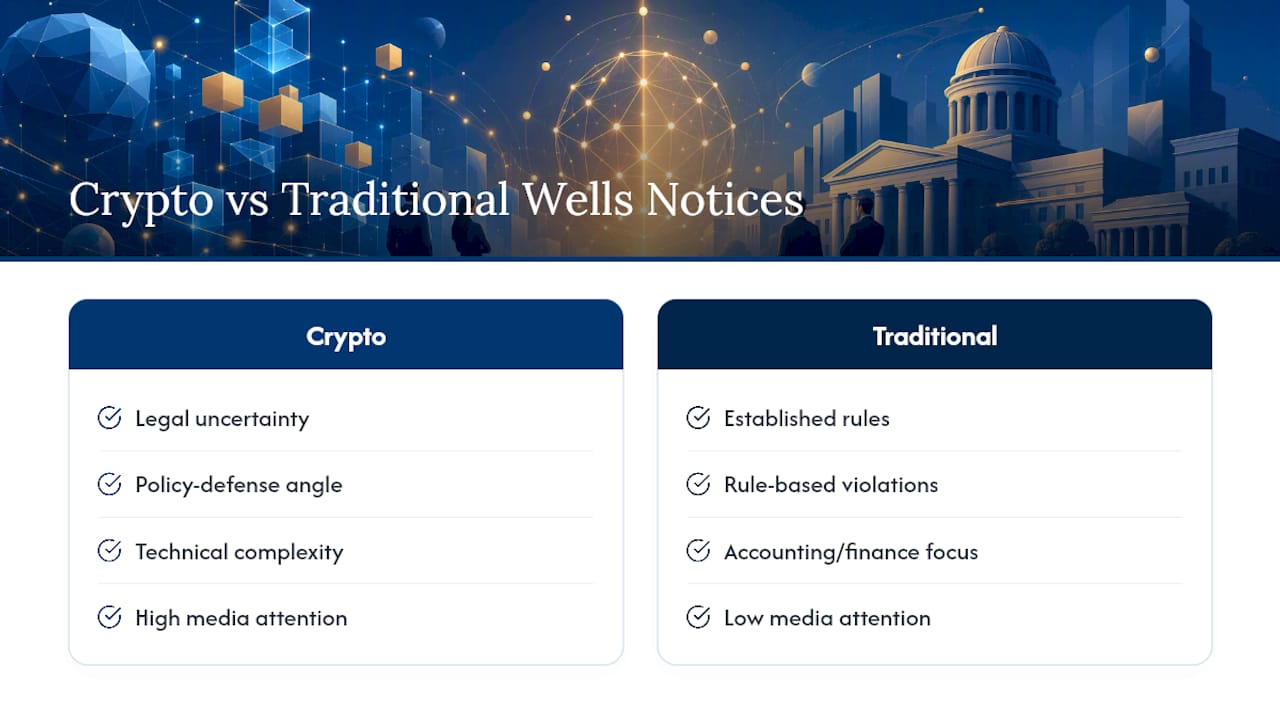
Wells notices aren’t unique to crypto. The SEC has used them for decades against broker-dealers, investment advisers, and public companies over accounting fraud or disclosure violations. What makes the crypto version different is the underlying legal uncertainty.
In a traditional securities case, the rules are usually clear before the conduct happens. A broker-dealer knows what “best execution” means; an adviser knows the fiduciary standard. In crypto, companies frequently argue, sometimes successfully, that the SEC is applying a decades-old legal test to a novel asset class without giving the industry clear rulemaking first. That argument doesn’t work in every case, but it gives crypto Wells submissions a policy dimension that a garden-variety accounting fraud matter never has.
Crypto matters also tend to involve more technical complexity. Staff and defense counsel alike need to understand blockchain architecture, token distribution mechanics, and decentralization metrics that simply don’t exist in a traditional Wells matter over, say, misleading revenue recognition. Expert witnesses in crypto cases often come from computer science or network analysis backgrounds rather than the accounting and finance experts common in traditional securities enforcement.
Finally, crypto Wells notices draw outsized public and media attention relative to their traditional counterparts. A Wells notice against a regional broker-dealer rarely makes headlines. A Wells notice against a major crypto exchange becomes industry news within hours, amplifying reputational and market consequences well beyond what the underlying allegations might otherwise generate.
What Happens Inside the SEC After a Wells Submission
Once your Wells submission lands, it goes to the enforcement staff who built the case, not to a judge or an independent reviewer. That’s an important distinction: the same team you’re arguing against is the team evaluating your argument.
Staff reviews the submission alongside the investigative record and decides whether to stick with its original recommendation, narrow it, or drop the matter. If staff decides to move forward, it drafts a formal recommendation memo to the Commission, which includes the proposed charges, the evidentiary basis, and often a summary of the arguments raised in the Wells submission.
The five commissioners then vote on whether to authorize the case. This is not a rubber stamp. Commissioners can, and sometimes do, push back on staff recommendations, particularly on novel legal theories where the law is unsettled. A change in Commission leadership or philosophy, the kind seen across 2024 and 2025, can shift how receptive commissioners are to aggressive crypto enforcement theories even when the underlying facts haven’t changed.
This internal process typically takes weeks to a few months after submission, though there’s no fixed statutory deadline. Firms sometimes use this window to continue settlement discussions in parallel, since staff and defense counsel often keep talking even after a formal submission is filed.
Public Scrutiny and Regulatory Pressure After a Wells Notice
News of a Wells notice rarely stays contained to legal circles. Crypto media, financial journalists, and social media accounts covering the space tend to amplify enforcement news within hours, often with speculation that outpaces the actual facts in the letter.
That scrutiny cuts both ways. On one hand, public pressure can push the SEC toward a faster resolution, since prolonged uncertainty draws criticism from industry advocates and sometimes members of Congress. On the other hand, high-profile coverage can make it politically harder for staff to quietly drop a matter, even when the legal case is weak, because doing so invites accusations of regulatory capture or inconsistency.
Industry reaction has grown more vocal over time. Coverage of the sector’s response to a wave of Wells notices highlights a recurring frustration: companies that engaged with the SEC in good faith, seeking guidance before launching products, still ended up facing enforcement anyway. That tension shapes how boards and executives think about proactive engagement with regulators going forward, and it’s one reason more firms now build regulatory inquiry response protocols before any letter ever arrives.
Murphy’s Law Perspective: Lessons From High-Profile Crypto Wells Matters
The firms that come out of a Wells notice in the best shape are the ones that treated documentation as a habit, not a scramble. On-chain evidence, compliance training records, and internal decision logs need to exist before the letter arrives, because reconstructing them under a 30-day deadline is a losing game.
Litigation experience changes how you read a Wells notice. A strong “efforts of others” rebuttal, built on real decentralization data rather than talking points, moves staff more than aggressive rhetoric ever does. And the decision to litigate versus settle usually comes down to one honest question: is the legal theory genuinely weak, or is the fight really about principle? Good early counsel gives you that answer before you’ve spent six figures finding out the hard way.
— Mark
Murphy’s Law: How We Help After a Wells Notice
Murphy’s Law offers legal services including Wells submissions, enforcement defense, forensic tracing, and compliance remediation, led by experienced litigators familiar with significant crypto cases. That combination matters: you’re not explaining blockchain basics to your lawyer while the clock runs.
If you’ve received a Wells notice, come to an initial consultation with the letter itself, your custody and compliance documentation, and a timeline of the conduct at issue. We’ll assess the legal theory, flag the strongest defense angles, and map out whether a submission, settlement talks, or litigation makes the most sense for your situation. Start with our crypto fraud recovery and legal options overview to see how our enforcement defense work fits alongside our fraud recovery litigation practice.
Where to Verify These Details
Read the SEC’s own Wells process materials and custody statement directly. For company-side context, see Robinhood’s Wells notice disclosure and regulatory disclosure analysis.
This article is general information, not a substitute for advice from a qualified lawyer. Consult a qualified legal professional about your own circumstances before acting on anything here.
Sources
- SEC Wells release (staff procedural material)
- What Is a Wells Notice and What Does It Mean? – Decrypt
FAQ
What does a Wells notice from the SEC mean?
It means SEC enforcement staff intends to recommend the Commission authorize a lawsuit against you, but it is not itself a charge and the Commission still has to vote on whether to proceed.
Does a Wells notice guarantee a lawsuit?
No. Staff can still recommend the original charges, narrow them, or drop the matter entirely after reviewing your Wells submission, and crypto examples like Uniswap Labs show cases closed without any enforcement action.
What is the typical timeline after receiving a Wells notice?
You generally get 30 days to file a written Wells submission, and the overall process from notice to a filing decision usually runs 60 to 180 days, though extensions and complex cases can stretch it longer.
Is the SEC’s lawsuit against XRP still open?
The SEC’s case against Ripple over XRP has largely concluded, with both sides resolving most claims and appeals; specific current status should be verified against the SEC’s own litigation releases since these matters can shift quickly.
What should I do first if my crypto company receives a Wells notice?
Preserve all relevant evidence immediately, including on-chain records and internal communications, and retain enforcement defense counsel experienced in crypto matters before drafting any response.