
Serving process on a crypto exchange in U.S. litigation almost always starts with a Rule 45 subpoena or its state-court equivalent, aimed narrowly at confirming an account exists before you ask for anything else. If the exchange or the named defendant sits overseas or hides behind a wallet address, plan for court-ordered alternative service under Rule 4(f)(3) while checking Hague Convention restrictions first. Pair every request with a preservation notice, and save asset-freeze requests for a separate emergency motion.
TL;DR:
- Serving a crypto exchange in U.S. litigation typically begins with a Rule 45 subpoena for domestic exchanges or Rule 4(f)(3) for foreign ones, depending on their location and U.S. presence.
- Subpoena requests must include precise blockchain identifiers like transaction hashes, exact timestamps, deposit addresses, and amounts to ensure swift processing by compliance teams.
- Alternative service under Rule 4(f)(3) requires thorough documentation of prior attempts and consideration of Hague Convention restrictions when the target is in a Hague member country.
- Freezing funds requires a separate court order; subpoenas alone only compel information, not asset holds, with emergency motions needing specific account identifiers and evidence of imminent fund withdrawal.
- Most exchanges respond within several weeks, with faster turnaround when requests are narrow, well-documented, and include a designated contact, especially when seeking urgent relief like a temporary restraining order.
Table of Contents
- What Legal Instrument Do You Use to Serve a Crypto Exchange?
- How Do You Draft a Subpoena Crypto Exchanges Will Actually Process?
- When Can You Use Alternative Service on an Offshore Exchange?
- Can a Subpoena Freeze a Scammer’s Crypto Account?
- How Long Does It Take an Exchange to Respond to a Subpoena?
- What Practitioners Get Wrong About Serving Crypto Exchanges
- How Murphy’s Law Handles Exchange Subpoenas and Emergency Relief
- Where to Verify the Rules Before You File
- Sources
- FAQ
What Legal Instrument Do You Use to Serve a Crypto Exchange?
Choosing the right instrument depends on where the exchange is registered, whether you already have a named defendant, and how fast the funds are moving. Get this wrong and you burn weeks chasing a defective service attempt while a scammer’s wallet empties out.
- Start with Rule 45 when you have a pending federal case. Federal Rule of Civil Procedure 45 governs subpoenas issued to third parties, and it is the workhorse tool for compelling account records, KYC data, and transaction history from a U.S.-registered exchange or one with sufficient domestic presence.
- Use Rule 4(f)(3) when the target is abroad and unreachable through normal channels. Rule 4 lets a court authorize alternative service on a defendant outside the United States, but only when the proposed method is not barred by an international agreement the U.S. has signed.
- File a Doe complaint paired with expedited discovery when you do not yet know who committed the fraud. This lets you subpoena the exchange that performed KYC on the relevant deposit address, then amend the complaint once a name surfaces, a sequence California courts have recognized in offshore and anonymous-defendant fraud cases.
Jurisdiction drives all three choices. An exchange with U.S. offices, a registered agent, or significant American customer volume is fair game for domestic service. An exchange operating entirely offshore with no U.S. footprint pushes you toward Rule 4(f)(3), and that is where most of the procedural risk in crypto litigation now lives.
How Do You Draft a Subpoena Crypto Exchanges Will Actually Process?
A subpoena that reads like a template written for a bank will sit in an exchange’s legal queue for weeks. Crypto exchanges route requests through compliance teams trained on blockchain data, and they need machine-readable specifics, not vague descriptions of “the account involved in this matter.”
Build every request around identifiers the exchange’s systems can actually search:
- Transaction hash for every transfer at issue
- Network name (Bitcoin, Ethereum, Tron, and so on) since the same hash format can exist on multiple chains
- Exact timestamps in UTC, not “on or about” a date
- Deposit and withdrawal addresses tied to the fraud
- Dollar or token amounts for each transfer
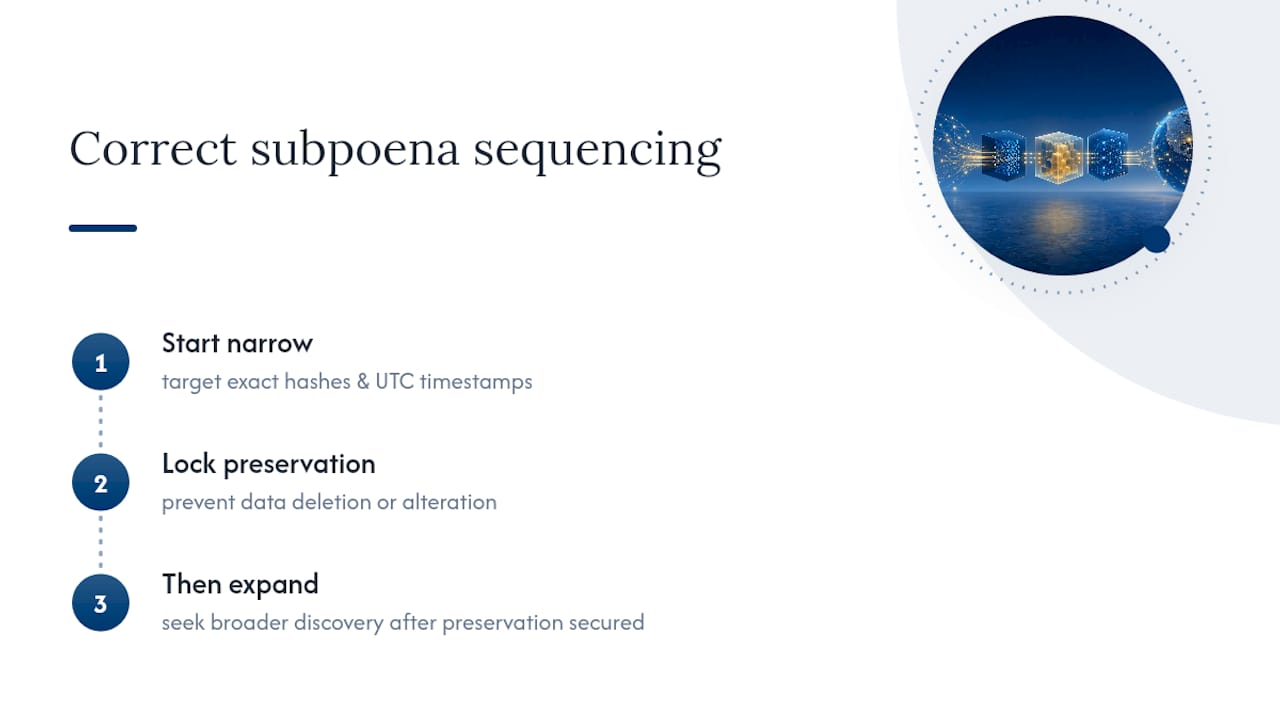
Sequence your requests. Practitioners get better results starting with an existence-only subpoena that simply confirms whether an account tied to a given address exists, then following with a broader request for transaction history and KYC records once that answer comes back. This phased approach avoids objections tied to overbreadth and keeps the exchange from tipping off a suspect too early in the case.
Every subpoena should also specify a custodian declaration under Federal Rule of Evidence 803(6), request production in native format rather than PDF screenshots, and propose a protective order for sensitive customer data. Give the exchange a realistic deadline. Thirty days is standard; demanding ten invites a motion to quash.
Pro Tip: Name a single point of contact on your subpoena cover letter and attach a one-page summary of how the funds were traced. Exchanges route requests faster when a compliance analyst does not have to hunt through the full complaint to understand why the account matters.
When Can You Use Alternative Service on an Offshore Exchange?
Rule 4(f)(3) sounds like a shortcut, but courts scrutinize these motions carefully, and getting the fact pattern wrong can cost you months.
- Check the destination country’s Hague Service Convention status before proposing email or social media service. Courts have denied alternative electronic service outright when the defendant sits in a Hague member state, since the Convention’s formal channels control unless the member state has objected to a specific method the Convention allows.
- Document every prior attempt at conventional service before filing your motion. Judges want to see that traditional methods were impracticable, not merely inconvenient, so attach affidavits showing failed delivery attempts or an exchange’s refusal to accept process through normal channels.
- Build your record around notice and due process, not just difficulty. Show the court that your proposed method (a registered agent, a known email, or U.S. counsel already in contact with the defendant) will actually reach the defendant and give them a fair chance to respond.
Recent rulings show courts remain split on whether serving a defendant’s U.S. counsel satisfies Rule 4(f)(3), but the decisions that side with plaintiffs lean heavily on evidence of actual notice, meaning the defendant knew about the case and had already communicated with that counsel. If you can show that pattern, cite it. If you cannot, expect a harder fight.
Can a Subpoena Freeze a Scammer’s Crypto Account?
No. A subpoena compels information, not a freeze. That distinction trips up a lot of plaintiffs who assume serving process on an exchange automatically locks down the funds.
If you need the account restrained, you need a separate court order, typically a temporary restraining order or preliminary injunction filed alongside or immediately after your subpoena. Exchanges will not restrain funds on a subpoena alone. They need a specific court order naming the exact account and directing the hold.
- Ask for a preservation notice first: a written request that the exchange retain records and account status pending further order, which costs nothing and buys time.
- Draft your TRO motion around precise account identifiers, the dollar amount at risk, and evidence the defendant is likely to move or withdraw funds before a hearing.
- Move fast. Crypto moves through mixers and cross-chain bridges in hours, not weeks.
Pro Tip: File your preservation request the same day you learn an account exists. It creates a paper trail showing the exchange was on notice even before your TRO motion lands on a judge’s desk. If your case calls for an emergency freeze, a preliminary injunction is the instrument built for exactly this problem.
How Long Does It Take an Exchange to Respond to a Subpoena?
Most exchanges route legal process through one of three channels: a registered agent for service of process, a dedicated law-enforcement or legal-request portal, or general in-house counsel. Submitting through a compliance-specific channel, when one exists, tends to move faster than mailing a registered agent and waiting for internal forwarding.
- Intake and validation (typically the first one to two weeks): the exchange confirms the subpoena is properly issued, checks jurisdiction, and assigns an internal case owner.
- Records search: compliance staff query internal systems using the hashes, addresses, and timestamps you provided; vague requests stall here.
- Legal review and production: the exchange applies redactions where required, attaches a custodian certification, and produces records, often in a structured export rather than a narrative document.
A well-documented case narrative, including a designated case owner and a short evidentiary summary of how the funds were traced, shortens the internal handoff time significantly. Expect objections around scope, especially if your subpoena reaches beyond the specific addresses at issue, and expect the exchange to insist on a protective order before releasing KYC data. Forensic deliverables should preserve raw transaction data with verifiable timestamps and hashed screenshots, since custodian certifications are what make those records admissible under Federal Rule of Evidence 803(6).
What Practitioners Get Wrong About Serving Crypto Exchanges
Most plaintiffs’ counsel treat exchange subpoenas like bank subpoenas, and that mismatch causes almost every delay in this practice area. Banks have decades of standardized compliance workflows. Exchanges are still building theirs, and the ones that respond fastest are the ones that get requests written in their own technical language.
The habit that actually works: start narrow, lock down preservation, and only then expand the ask. Liam Murphy has applied that sequencing across cases involving Celsius, Terraform Labs, and BitMEX, where the difference between a stalled subpoena and a productive one usually came down to whether the request named exact hashes and timestamps instead of describing an account in general terms. Murphy’s Law built its recovery practice on that litigation-first discipline rather than the informal “recovery service” model that has no court authority to compel anything.
— Mark
How Murphy’s Law Handles Exchange Subpoenas and Emergency Relief
Murphy’s Law is a licensed litigation firm, not one of the unregulated recovery outfits that promise to “get your crypto back” with no court filing behind them. That distinction matters when a scammer’s exchange account needs to be frozen before it empties out, because only a firm with real courtroom standing can walk into a courthouse and get a judge to sign a temporary restraining order the same week.
The firm handles crypto fraud recovery litigation from the first existence-only subpoena through emergency injunctive relief, and coordinates the blockchain forensics that make a subpoena response admissible in court rather than just informative. If your funds are still moving and you need a freeze order drafted this week, the firm’s temporary restraining order practice is built for exactly that timeline. Reach out through the firm’s site to get a case assessment started and find out which instrument fits your situation before the trail goes cold.
Where to Verify the Rules Before You File
Confirm the underlying rule text and treaty status directly before drafting any motion:
- Federal Rule of Civil Procedure 45 for subpoena authority and scope.
- Federal Rule of Civil Procedure 4 for alternative service standards under Rule 4(f)(3).
- Practitioner guidance on locating exchange accounts for phased subpoena language.
This article is general information, not a substitute for advice from a qualified lawyer. Consult a qualified legal professional about your own circumstances before acting on anything here.
Sources
- Federal Rules of Civil Procedure, Rule 45
- Federal Rules of Civil Procedure, Rule 4
- Locating Crypto Exchange Accounts | Hudson Intelligence
- Memorandum decision denying email service where Hague Convention applies (2026)
FAQ
How long does it take to serve a crypto exchange with a subpoena?
Most exchanges take several weeks to validate and respond to a properly drafted subpoena, though a narrow, existence-only request with exact transaction hashes and timestamps moves faster than a broad demand for full account history.
Can a subpoena freeze funds in a crypto exchange account?
No, a subpoena only compels the exchange to produce information. Freezing an account requires a separate court order such as a temporary restraining order or preliminary injunction, which are typically filed alongside expedited discovery.
How do you serve an anonymous crypto scammer with no known address?
File a Doe complaint and use expedited discovery to subpoena the exchange that performed KYC on the fraud address, which typically reveals the defendant’s identity so you can amend the complaint and pursue standard service.
Can you serve a foreign crypto exchange by email?
Only in limited circumstances. If the exchange or defendant sits in a country that is a Hague Convention member, courts have denied email service because the Convention’s formal channels control unless that method is affirmatively allowed.
What should an emergency motion to freeze crypto assets include?
It should name the exact account and wallet identifiers at risk, show evidence the defendant is likely to move funds before a hearing, and request specific preservation and restraint language the exchange can act on immediately. Murphy’s Law drafts these motions as part of its preliminary injunction practice for clients facing an active fund drain.