
A token legal opinion is a dated, fact based conclusion from counsel that reduces legal uncertainty for exchanges and partners, but it does not guarantee listing. If you’re preparing for exchange review, your first move is to build a dated factual record and hire counsel before marketing or distribution decisions get harder to unwind. The opinion’s value depends entirely on its stated scope, assumptions, and how quickly you refresh it after material changes.
TL;DR:
- A token legal opinion provides a dated, fact-based conclusion on securities law compliance but does not guarantee listing approval.
- Building a comprehensive, verifiable evidence folder and engaging counsel early can streamline the review process and reduce delays.
- Regular updates are necessary when token features or market conditions change, especially after regulatory guidance on staking, wrapping, or yield activities.
- Exchange review involves multiple parallel checks, including legal, compliance, and technical security, which depend on clear documentation and fast responsiveness.
- Scope is limited to the jurisdiction and facts presented; cross-border and different token classifications require separate analysis for global listings.
Table of Contents
- What a Token Legal Opinion Actually Is
- What Lawyers Review Before Drafting an Opinion
- How Exchange Legal, Compliance, and Technical Reviews Fit Together
- Building an Exchange-Ready Submission Package
- Why Legal Opinions Have Limits, and When to Refresh One
- An Actionable Timeline for Getting Listing-Ready
- Key Regulatory Jurisdictions and Their Requirements
- Utility Tokens vs. Security Tokens: Different Review Standards
- Recent Regulatory Developments Reshaping Token Listings
- Why Litigation Experience Changes How an Opinion Gets Written
- Get Your Token Exchange-Ready With Murphy’s Law
- Primary Sources Worth Reading Directly
- Sources
- FAQ
What a Token Legal Opinion Actually Is
An opinion of counsel is not an exchange approval, and it is not a regulatory safe harbor. It is a lawyer’s dated conclusion, based on a specific set of facts and assumptions, about how a token’s structure and distribution fit existing securities law. Exchanges treat it as one input in a broader review, not a substitute for their own diligence, as Coinbase’s asset legal review process makes explicit.
A properly drafted opinion contains several fixed components:
- A factual recitation describing exactly what the lawyer reviewed and when
- Explicit assumptions the analysis relies on, including facts the lawyer could not independently verify
- A defined jurisdictional scope, since securities treatment varies by country and sometimes by state
- Reliance clauses stating who may rely on the opinion and for what purpose
- A conclusion tied narrowly to the facts recited, not a general endorsement of the project
Exchanges request opinions because they allocate risk. A well scoped opinion, paired with a clean factual record, tells a compliance team the project has already done the hard work of identifying its own legal exposure. That is a trust signal worth more than marketing copy, and it is why sophisticated founders treat the opinion process as infrastructure, not paperwork.
What Lawyers Review Before Drafting an Opinion
Counsel cannot write a defensible opinion from a whitepaper alone. The review pulls from four categories of evidence, and gaps in any one of them slow the entire process.
- Public-facing materials. The whitepaper, website copy, marketing decks, and social media statements all get reviewed for promises of profit, managerial effort, or price appreciation, since promotional language can shift a token’s legal character even when the code says otherwise.
- Tokenomics and distribution records. Cap tables, vesting schedules, treasury allocations, and any pre-sale or private-sale terms need to be documented with dates and counterparties, not summarized from memory.
- Technical artifacts. Counsel wants deployed contract addresses, links to the source code repository, third-party audit reports, and block explorer records showing actual on-chain behavior.
- Operational contracts. Custody arrangements, market-making agreements, listing agreements, and advisor or consulting contracts often contain language about token allocations or performance expectations that contradicts public statements.
Compliance evidence rounds out the file: a documented KYC and AML program, sanctions screening records, and on-chain monitoring procedures for suspicious activity. Regulators and counsel now weigh promotional statements alongside code, since managerial promises can change how an asset is classified regardless of its technical design.
Pro Tip: Keep a single, dated folder where every document version lives, including retired drafts. Counsel needs to know exactly which whitepaper version was live on which date, not just the current one.
How Exchange Legal, Compliance, and Technical Reviews Fit Together
Exchanges do not run a single legal check. Coinbase’s published process runs legal, compliance, and technical-security reviews in parallel, each feeding into a business decision about whether to list at all, according to Coinbase’s own listing process guide.
Legal review focuses on Howey analysis inputs: how the token was sold, what buyers were promised, and whether governance rights are real or cosmetic. Compliance review checks distribution transparency and AML exposure, often cross-referencing the same wallet data counsel already reviewed. Technical-security review examines the smart contract itself, checking for admin keys, upgrade authority, or mint functions that could let insiders change supply after launch.
A favorable opinion helps clear the legal track, but it does not bind the exchange on the others. Exchanges still consider:
- Whether the asset fits their regional licensing footprint
- Business priority and expected trading volume
- Independent technical findings that may contradict claims in the whitepaper
Founders who respond fast to follow-up requests, rather than treating the initial submission as final, consistently move through review faster than teams that submit once and wait.
Building an Exchange-Ready Submission Package
An evidence folder beats a single PDF. Exchanges and counsel both work faster when every claim in the opinion traces back to a specific document, dated and versioned.
- Core disclosure documents. The dated whitepaper, deployed token contract addresses, and completed third-party audit reports, submitted exactly as reviewed with no undocumented revisions.
- Block-explorer snapshots. Screenshots or exports showing token supply, holder distribution, and transaction history at the time of review, since on-chain data changes and counsel needs a fixed reference point.
- Allocation and treasury proof. The cap table, vesting schedules, grant letters to advisors and team members, and wallet addresses with transaction evidence showing actual disbursements matched to the stated schedule.
- Compliance and AML artifacts. A written KYC policy, screening provider reports, sanctions check logs, and documentation of ongoing AML monitoring procedures.
- A version-controlled change log. A simple record of what changed, when, and why, so counsel can state precisely which version of each document the opinion covers.
Coinbase’s own guidance notes that projects clearly stating token purpose, governance rights, and real-world usage, while avoiding profit-oriented marketing, tend to move through review with fewer delays. That single habit, matching public language to the actual legal structure, resolves more friction than any amount of additional paperwork.
Why Legal Opinions Have Limits, and When to Refresh One
An opinion is only as strong as the facts it recites and the assumptions it states. It is not an exchange approval, and it is not a universal safe harbor, a point Coinbase’s asset-listings page reinforces directly.
Several events can undermine an opinion after the fact:
- Undisclosed distributions or side deals not reflected in the cap table counsel reviewed
- Marketing that shifts toward profit promises after launch
- Adding staking, wrapping, or yield features that change how the token functions
- New minting authority or governance changes that alter the token’s economics
Recent federal action on staking and wrapping activity means these features specifically warrant a fresh look before you add them. Pro Tip: Treat any planned tokenomics change, even one that seems minor, as a trigger for a call to counsel before launch, not after a regulator asks about it.
An Actionable Timeline for Getting Listing-Ready
Most founders underestimate how much of the timeline they control. Coinbase reports that due diligence itself can take about one week once a submission is complete, with trading enabled within weeks of approval, but incomplete governance or technical documentation is what stretches that window into months.
- Weeks 0 to 2: Assemble the dated factual record, lock down current versions of every public document, and run initial sanctions and AML screening on major wallet addresses.
- Weeks 2 to 4: Engage counsel for intake, where they identify gaps in your evidence folder before drafting begins.
- Weeks 4 to 8: Counsel drafts the opinion, flags remediation items, and you close evidence gaps, such as missing vesting documentation or unclear custody arrangements.
- Weeks 8 to 12: Counsel finalizes the opinion and evidence folder, and you submit to your target exchange with the full package.
- Weeks 12 to 16: Respond to exchange follow-up requests, which move faster when your evidence folder already anticipated the likely questions.
A realistic path runs 8 to 16 weeks from first counsel contact to submission, and teams that prepare documentation before engaging a lawyer routinely land at the shorter end. Our guide on the 8 to 16 week path to a legal token listing breaks this timeline down further for teams building their own internal checklist.
Key Regulatory Jurisdictions and Their Requirements
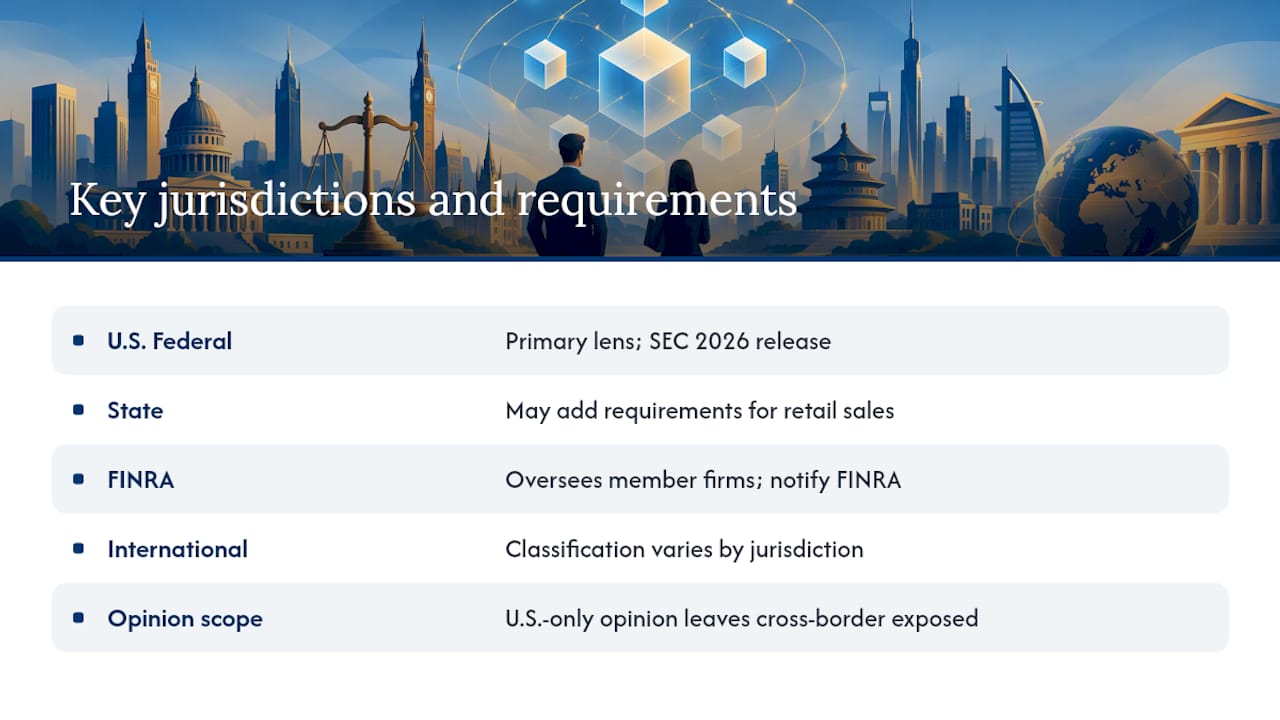
Federal securities law remains the primary lens for U.S. token listings, and the SEC’s 2026 interpretive release specifically addresses how digital commodities, collectibles, tools, stablecoins, and digital securities are distinguished, along with how a token that starts as a non-security can still become subject to investment contract analysis through its sale structure. That release is essential reading for any U.S. counsel drafting a listing opinion.
State-level securities regulators can layer additional requirements on top of federal analysis, particularly for tokens marketed to retail buyers within a specific state. FINRA oversight extends into how member firms handle any crypto-related nexus, recommending that firms notify FINRA directly about crypto activities rather than assume existing licenses cover token dealings, according to FINRA’s regulatory oversight reporting.
Outside the United States, jurisdictions vary widely in how they classify tokens, and an opinion scoped to U.S. law says nothing about whether the same token faces different treatment in the EU, UK, or Asian markets where an exchange also operates. This is why opinion scope matters so much: a document limited to “United States federal securities law” protects you domestically but leaves cross-border exchange listings exposed unless you commission separate jurisdictional analysis. Our breakdown of recent SEC crypto regulations covers how these federal categories interact with state-level enforcement.
Utility Tokens vs. Security Tokens: Different Review Standards
The depth of legal review changes substantially depending on how a token is likely to be classified, and founders who assume “utility token” status without documentation are taking on real risk.
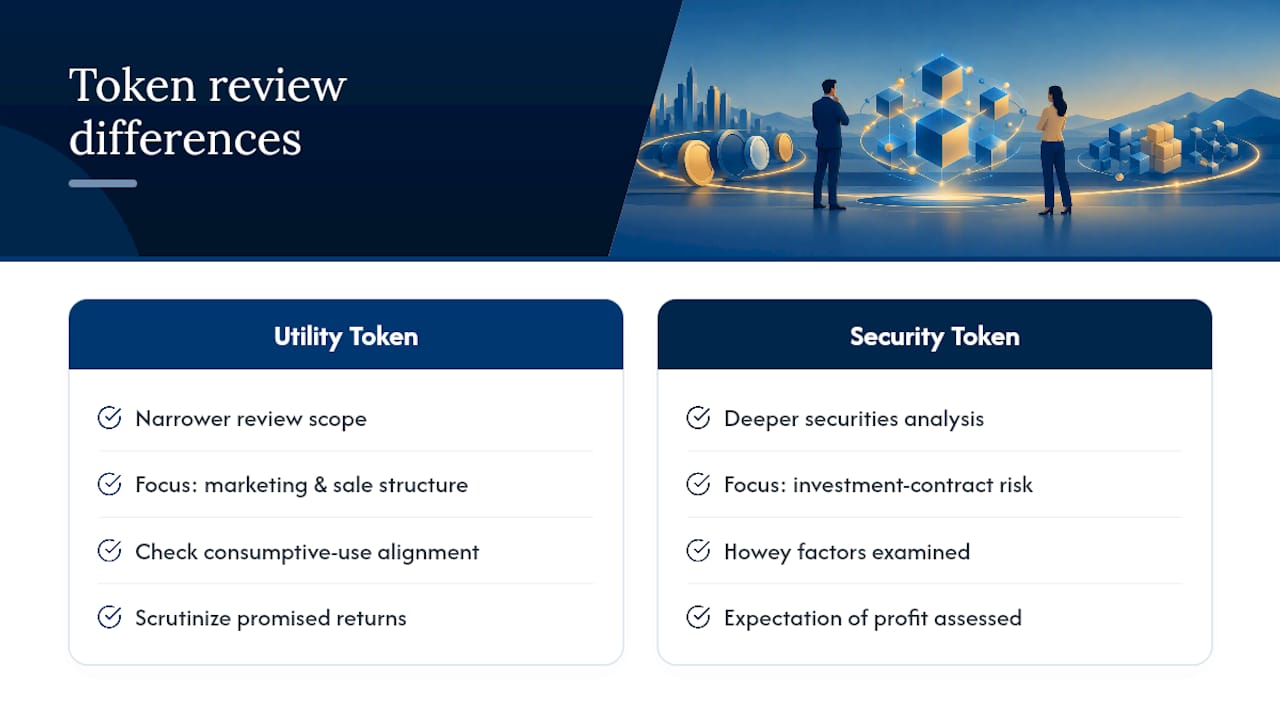
A token marketed purely for consumptive use, redeemable for a specific service with no profit expectation attached, faces a narrower review focused on whether marketing language and sale structure match that stated purpose. Counsel will scrutinize whether presale investors were promised returns, whether the token trades on secondary markets before the underlying platform even launches, and whether governance rights are functional rather than decorative.
A token that behaves like an investment contract, where buyers reasonably expect profit from the efforts of a common enterprise, requires a fundamentally different analysis. Here, counsel examines the same Howey factors that apply to traditional securities: investment of money, common enterprise, expectation of profit, and reliance on the efforts of others. Our compliance guide on securities law risks walks through how sale structure and marketing promises can push a token from one category into the other, often without the founders intending it.
The practical takeaway: don’t self-label your token. Build the factual record first, let counsel apply the analysis, and treat any ambiguity as a reason to over-document rather than assume the favorable classification.
Recent Regulatory Developments Reshaping Token Listings
The 2026 SEC interpretive release marks the most significant clarification in years for how staking, wrapping, and airdrop activity affects a token’s legal status. Activities that once seemed like harmless product features, letting holders stake tokens for yield or wrap them for cross-chain use, can now trigger fresh investment contract analysis under the guidance tied to CFTC and Federal Register rulemaking.
This matters directly for listing timelines. A token that received a clean opinion eighteen months ago, before the project added a staking feature, is operating on a stale analysis. Exchanges reviewing that token today will ask whether the opinion accounts for the new mechanic, and if it doesn’t, expect a request for supplemental analysis before listing proceeds.
The practical response is to treat regulatory developments as a standing agenda item, not a one-time compliance check. Teams that build in a quarterly review of whether tokenomics changes, new features, or updated guidance affect their existing opinion move through exchange follow-up far faster than teams caught flat-footed by a question they haven’t considered since launch. Airdrops deserve particular attention here, since they carry their own distinct analysis under the current framework, covered in more detail in our guide to airdrop legal considerations.
Why Litigation Experience Changes How an Opinion Gets Written
Lawyers who have never argued a crypto case in front of a judge draft opinions differently than lawyers who have. Litigation experience forces a specific discipline: identify the adverse facts before opposing counsel or a regulator does, state assumptions in language that holds up under cross-examination, and build an evidence folder that could survive discovery, not just satisfy a compliance checklist.
Firm attorney Liam Murphy has litigated matters involving Celsius, Terraform Labs, and BitMEX, work that surfaces recurring patterns in how exchanges and regulators actually respond to gaps in a factual record. That experience shapes how opinions get scoped from the start, with reliance language and assumptions written to withstand scrutiny rather than simply check a box. In practice, that means closing evidence gaps, like unclear custody arrangements or undocumented wallet transfers, before an exchange’s follow-up request ever arrives.
— Mark
Get Your Token Exchange-Ready With Murphy’s Law
Assembling a dated factual record, closing evidence gaps, and drafting an opinion that anticipates exchange follow-up takes legal judgment that most in-house teams don’t build until after their first rejected submission. Certain legal service providers work directly with founders and legal teams to produce the opinion and the evidence folder together, not as separate deliverables, drawing on courtroom experience with contested crypto matters rather than boilerplate templates.
An engagement typically covers a dated legal opinion scoped to your actual token mechanics, a versioned evidence folder matching everything counsel reviewed, and a remediation plan for any gaps identified before submission. For projects facing regulatory questions on top of listing prep, the firm’s crypto compliance consulting work covers both readiness and defense in the same engagement. Visit the services page to review the full range of listing and compliance work, and reach out to schedule a consultation before your next submission window.
Primary Sources Worth Reading Directly
Founders and counsel benefit from reading the primary documents rather than summaries.
- The SEC’s 2026 interpretive release defines token categories and investment contract triggers directly from the source.
- Coinbase’s listing process guide explains the exchange’s own legal, compliance, and technical-security tracks.
- Coinbase’s asset legal review page sets expectations for what founders should submit.
- FINRA’s oversight report covers AML and supervision exposure tied to crypto activity.
- Federal Register materials on staking and wrapping explain why these features carry legal weight.
Sources
- Asset legal review | Coinbase Help
- A Guide to the Digital Asset Listing Process at Coinbase
- Application of the Federal Securities Laws to Certain Types of Crypto Assets and Certain Transactions Involving Crypto Assets (SEC Release)
- Member Firms’ Nexus to Crypto | FINRA
- CFTC final rule and Federal Register material (2026)
FAQ
What Is a Token Listing Service?
A token listing service typically refers to the exchange’s own process for evaluating a digital asset before making it available for trading, covering legal, compliance, and technical-security review, as described in Coinbase’s listing process guide. It’s distinct from the token legal opinion, which is a document counsel prepares to support that review.
Are Cryptocurrencies Legal Tender?
No cryptocurrency is treated as federal legal tender in the United States. Whether a specific token is a security, commodity, or something else instead depends on facts like its sale structure and marketing, a distinction the SEC’s 2026 interpretive release addresses directly.
How Do You Get Listed on a Crypto Exchange?
Getting listed generally requires submitting a complete evidence package, including a whitepaper, tokenomics documentation, audited source code, and often a legal opinion, then passing the exchange’s parallel legal, compliance, and technical-security reviews. Coinbase notes that due diligence itself can move in about a week once submissions are complete, but incomplete documentation is what typically causes delays.
What Legal Issues Come Up Most in Token Reviews?
The most common issues involve marketing language that implies profit expectations, undocumented distributions or side deals, and technical features like staking or new mint authority that were added without updating the underlying legal analysis. Firms like Murphy’s Law work through these gaps directly with founders before submission rather than after an exchange flags them.
Does a Legal Opinion Guarantee My Token Gets Listed?
No. An opinion reduces legal uncertainty and supports the exchange’s own legal review, but exchanges run independent compliance and technical-security checks and retain full discretion over listing decisions, as Coinbase’s asset legal review page states directly.