
Yes, a token can be listed legally in the United States, but only if it clears one gate first: securities classification under the Howey test. If the token functions as an investment contract, the issuer needs registration or a valid exemption before any exchange will touch it. The SEC’s 2026 proposals offer new exemption paths, but none of them replace the need for a jurisdiction-specific legal opinion, a clean AML/KYC program, and a compliance record exchanges can verify before listing day.
TL;DR:
- Tokens promising guaranteed returns, sold via SAFT, or controlled centrally are strong indicators they will be classified as securities under the Howey test.
- Regulatory exemptions like Regulation D, Regulation S, and Regulation A+ have strict resale restrictions and filing requirements influencing how quickly tokens can list.
- Exchange approval hinges on a comprehensive legal opinion and detailed documentation covering token classification, tokenomics, audit reports, and AML/KYC compliance.
- Listing compliance does not end at approval; ongoing obligations include money transmitter licensing, periodic reporting, and rigorous AML/KYC programs.
- Rushing legal classification or disclosure processes increases the risk of delayed listings or regulatory sanctions, so a staged approach prioritizing correctness over speed is recommended.
Table of Contents
- Token Listing Legal Requirements: How the Howey Test Decides Your Fate
- Regulation Crypto Assets: What the SEC’s 2026 Rules Actually Change
- Reg D, Reg S, and Reg A+: Choosing the Right Offering Structure
- What Exchanges Actually Require Before They’ll List Your Token
- AML, Money Transmission, and What Happens After You List
- What Experienced Counsel Actually Delivers for a Token Listing
- Speed Versus Certainty: When to Slow Down a Token Launch
- How Murphy’s Law Helps You List a Token the Right Way
- Primary Sources Worth Reading Before You File
- Sources
- FAQ
Token Listing Legal Requirements: How the Howey Test Decides Your Fate
Every token listing in the U.S. runs through the same filter before anything else matters: is this thing a security? The answer comes from a 1946 Supreme Court case about Florida orange groves, and it still governs crypto compliance in 2026.
The Howey test asks four questions. Is there an investment of money? Is it in a common enterprise? Does the buyer expect profit? Does that profit depend on the managerial efforts of someone else? A token clears all four factors when investors buy it hoping a founding team, a foundation, or a core development group will do the work that makes the token valuable. That’s the pattern regulators watch for, and it’s the pattern that turns a “utility token” sale into an unregistered securities offering.
The SEC’s 2026 interpretive release sharpens this further. It states that classification depends on economic substance, not on what the whitepaper calls the token. A project can call its asset a “network access credit” and still get treated as a security if the marketing promises returns tied to the team’s future performance. The release specifically calls out marketing language and issuer representations as dispositive evidence, meaning what you say in a Telegram channel or a pitch deck can matter as much as what the smart contract does.
The CFTC complicates this picture rather than simplifying it. Bitcoin and Ether are widely treated as commodities, which puts certain derivatives and spot trading activity under CFTC oversight. But commodity treatment for one token doesn’t clear every token of securities exposure. Classification is fact specific, and enforcement responsibility can shift depending on how a token is sold, marketed, and structured, not just what category it falls into on a given day.
Several patterns reliably push a token toward security status, and any founder planning a listing should treat these as warning flags rather than marketing opportunities:
- Promising staking yields or “guaranteed” returns tied to protocol performance
- Selling through a SAFT (Simple Agreement for Future Tokens) that explicitly frames the purchase as an investment
- Retaining centralized control over token supply, minting, or protocol upgrades after the sale
- Marketing the token primarily to speculative buyers rather than to users of an existing product
- Using proceeds from the sale to fund ongoing development that the buyer is relying on for the token’s future value
None of these factors is automatically fatal. But stack two or three together, and you’ve built a fact pattern the SEC has litigated successfully before, most notably in the Terraform Labs enforcement matters that reshaped how issuers think about token marketing.
Regulation Crypto Assets: What the SEC’s 2026 Rules Actually Change
In August 2026, the SEC proposed Regulation Crypto Assets, the first rule package built specifically for token offerings rather than borrowed from decades-old securities exemptions. It creates two new offering paths and a conditional safe harbor, and any issuer weighing a U.S. listing needs to understand exactly how narrow those paths are.
The first exemption covers startup-stage raises: up to $5 million over a rolling four-year period. The second covers larger fundraising: up to tens of millions of dollars within a year, according to the SEC’s own release. Both come with principles-based disclosure obligations rather than the line-item requirements of a traditional S-1, and the larger exemption carries ongoing reporting duties that persist after the raise closes.
By the numbers: Regulation Crypto Assets caps
- maximum raise under the startup exemption, measured over multiple years
- maximum raise under the fundraising exemption, measured over a 12-month period
- two tracks total, each with its own disclosure and reporting profile
The proposed rule text also introduces a conditional safe harbor from the “investment contract” label itself. If an issuer meets specific structural conditions, the token can potentially avoid securities classification altogether rather than merely qualifying for an exemption. That distinction matters for exchanges, since a token that has genuinely exited investment contract status faces fewer downstream restrictions than one that relied on an exemption to sell but remains a security in every other respect.
Rule 103(b), part of the proposed rule text, lists the specific disclosure topics issuers would need to address regardless of which exemption they use. These include token economics and supply mechanics, governance structure and who controls upgrades, security architecture and known vulnerabilities, source code status and audit history, and any conflicts of interest between the issuer and token holders. Larger raises under the $75 million path would also need financial statements and periodic reporting once the offering closes, closer to what a Regulation A+ issuer already provides.
Here’s what this means practically for exchange readiness. Compliance teams at major platforms are already treating these proposed disclosure topics as a preview of what their own due diligence checklists will demand, whether or not a given token actually relies on the new exemptions. A project that voluntarily prepares Rule 103(b)-style disclosures now, even ahead of final rule adoption, walks into exchange review with documentation that maps directly onto what reviewers expect to see. Waiting for the rule to finalize before building that file is the slower path, not the safer one.
Reg D, Reg S, and Reg A+: Choosing the Right Offering Structure
Before Regulation Crypto Assets existed, and still today for most issuers, three exemptions carry the bulk of U.S. token offerings. Each solves a different problem, and picking the wrong one is one of the most common reasons a listing gets delayed at the exchange review stage rather than at the SEC.
Regulation D covers private placements to accredited investors. Rule 506(b) allows a limited number of non-accredited investors and bars general solicitation, while 506© permits public advertising but requires verified proof of accredited status for every buyer. Both require filing a Form D with the SEC, and that filing has a strict deadline: within 15 days of the first sale. Tokens sold under Reg D typically carry a one-year resale restriction before they can trade freely, which matters enormously for anyone planning an exchange listing shortly after the raise closes.
Regulation S covers offshore sales to non-U.S. persons and is almost always paired with Reg D rather than used alone, since most token projects want both domestic accredited investors and international participation. The compliance burden here centers on genuinely verifying that buyers are outside the U.S., not just checking a box on a form.
Regulation A+ (Tier 2) functions as a mini-IPO, allowing raises up to $75 million with SEC qualification and ongoing reporting obligations similar to a public company, minus full Exchange Act registration. It’s slower and more expensive to execute than Reg D, but it produces tokens that can trade to retail investors from day one, no accredited-investor restriction, no lockup period identical to a private placement.
Some practical patterns show up repeatedly among issuers who get this right:
- Reg D 506© combined with Reg S covers most token sale structures that need both accredited U.S. buyers and offshore participants
- Reg A+ makes sense when the goal is a token that lists and trades openly to retail buyers almost immediately after the raise
- The new Regulation Crypto Assets exemptions, once finalized, will likely appeal most to smaller projects that don’t need the $75 million ceiling and want a lighter disclosure lift than full Reg A+ qualification
Whichever path you choose, the resale restrictions and Form D timing directly determine how fast you can move from raise to listing. Projects that ignore this timeline routinely find themselves sitting on tokens that are legally raised but not yet freely tradable when the exchange asks for a listing date.
What Exchanges Actually Require Before They’ll List Your Token
Getting the securities analysis right is necessary, but it’s not the same thing as getting listed. Exchanges run their own due diligence process, and it’s built around one core document plus a stack of supporting proof.
The centerpiece is the legal opinion, and it needs to be written for the specific jurisdiction where the exchange operates, not as a generic global memo. Practice guidance in this space consistently warns against relying on a single opinion covering every market; U.S.-facing exchanges want a Howey-focused analysis addressing the token’s status specifically for American users, separate from any EU or Singapore analysis covering other jurisdictions.
Here’s what a complete listing package typically includes, roughly in the order exchanges request it:
- Token classification memo addressing Howey factors, economic substance, and any safe harbor or exemption relied upon
- Tokenomics verification showing supply schedule, allocation percentages, and distribution history matched against on-chain records
- Vesting and lockup documentation proving founder and team allocations follow the schedule disclosed to investors
- Smart contract audit report from an established auditing firm, addressing known vulnerability classes and upgrade mechanisms
- AML/KYC program documentation covering sanctions screening, transaction monitoring, and onboarding procedures
- Proof of liquidity demonstrating the token can support trading depth without immediate manipulation risk
- Corporate governance records showing who controls treasury funds, protocol upgrades, and emergency intervention powers
- Staking and rewards treatment analysis if the token offers yield, since reward mechanics are a frequent trigger for renewed securities scrutiny
Exchanges commonly require audits from established firms and demonstrable on-chain evidence of vesting compliance before a listing application even moves to technical review. Skipping this step is the single most common reason applications stall for months rather than weeks.
Pro Tip: Build your legal opinion and your tokenomics documentation in parallel, not sequentially. Exchanges cross-reference the two, and any mismatch between what the opinion claims about distribution and what the blockchain actually shows will stop your application cold.
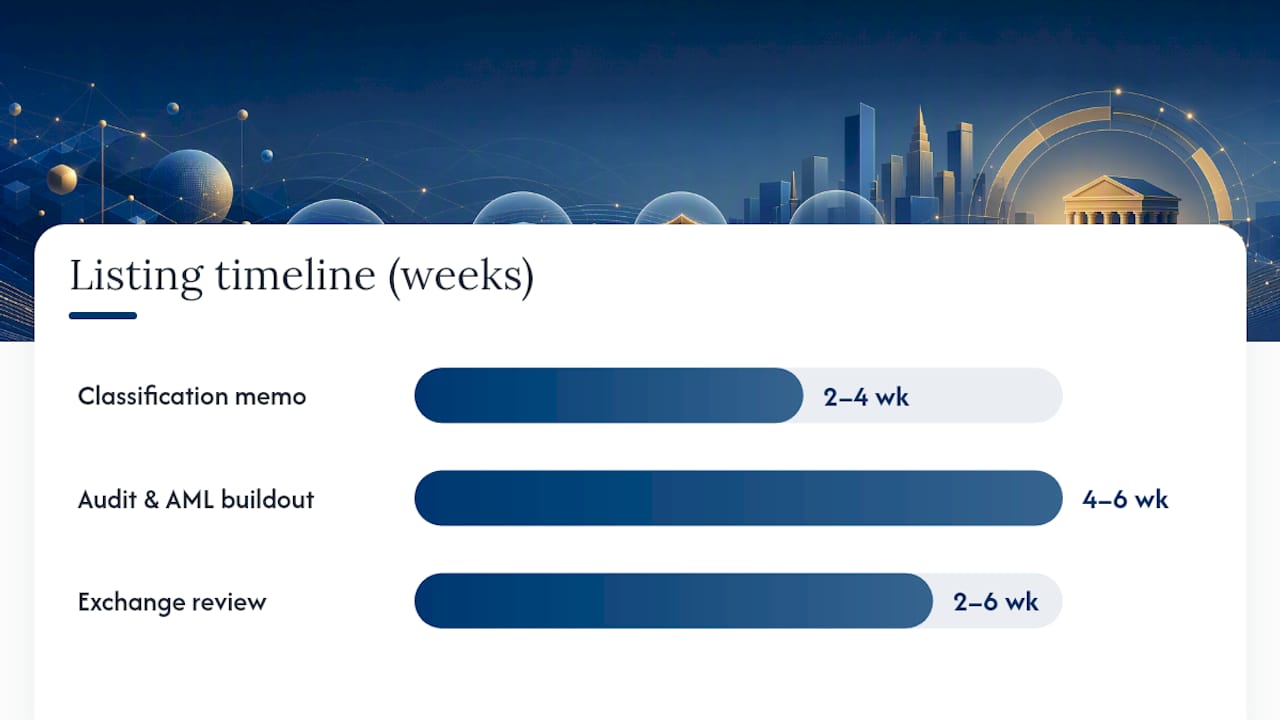
A realistic timeline for assembling a full package runs eight to sixteen weeks: two to four weeks for the initial classification memo, four to six weeks for the audit and AML program buildout running concurrently, and two to six weeks for exchange review once the package is submitted. Rushing any single piece almost always adds time back somewhere else, usually at the review stage when the exchange sends the application back with questions. Founders should also review a token launch compliance checklist before starting this process, since it maps the same requirements exchanges will independently verify.
AML, Money Transmission, and What Happens After You List
Getting listed is the finish line for the legal analysis, not the compliance program. Several obligations kick in the moment tokens start trading, and issuers who treat listing day as the end of their legal work tend to end up back in front of a regulator within a year.
Money transmission licensing is the piece most token teams underestimate. If the issuer or an affiliated entity is transmitting value on behalf of users, whether through a native wallet, a custodial staking service, or a fiat on ramp, state money transmitter licensing can apply. This is state by state, not federal, and a project that hasn’t mapped its licensing exposure across the states where it has meaningful user volume risks losing exchange access if a state regulator intervenes after listing.
A minimum viable AML/KYC program that exchanges and regulators expect includes:
- Identity verification calibrated to transaction size and risk tier, not a flat one-size checkbox
- Sanctions screening against OFAC lists at onboarding and on an ongoing basis
- Transaction monitoring capable of flagging structuring, layering, or unusual volume spikes
- A designated compliance officer or function responsible for filing suspicious activity reports when warranted
- Documented escalation procedures for high-risk jurisdictions and politically exposed persons
Post-listing, issuers who relied on Regulation D face ongoing Form D amendment obligations if the offering terms change, and issuers who used the larger Regulation Crypto Assets exemption should expect periodic reporting duties that don’t disappear once the token trades. Tax reporting adds another layer: token sales, staking rewards, and any airdrops tied to the offering can trigger reporting obligations for both the issuer and, in some cases, the exchange facilitating trades. Projects distributing tokens through airdrops in particular should review the legal considerations specific to airdrop structures, since regulators increasingly treat airdrops as a distribution mechanism subject to the same securities scrutiny as a direct sale.
What Experienced Counsel Actually Delivers for a Token Listing
A law firm working token listings for U.S. clients produces a specific set of deliverables, not general advice. That starts with a token classification memo addressing Howey factors and economic substance directly, followed by an exchange-targeted legal opinion written for the specific platform and jurisdiction in question rather than a generic global document.
From there, the work turns into a tailored disclosure schedule matching Rule 103(b)’s proposed topics as outlined in the Public Company Transparency Regulatory Assessment Guide, an AML/KYC program built to the risk profile of the actual token, and investor onboarding protocols that hold up under exchange review. A law firm working token listings approaches this work the way litigators approach discovery: assume every document will eventually be tested, and build the file accordingly.
Some litigation experts have litigated high-profile matters in crypto, including cases tied to Celsius, Terraform Labs, and BitMEX. That courtroom background shapes how compliance files for issuers are built: not as paperwork to file and forget, but as the record that will get scrutinized if a regulator or a plaintiff’s attorney ever comes asking.
Speed Versus Certainty: When to Slow Down a Token Launch
The pressure on most token teams is to launch fast, list fast, and capture momentum before the market moves on. That instinct is understandable and frequently wrong. A rushed legal opinion that skips jurisdiction-specific analysis is worse than no opinion at all, because it gives an exchange false confidence right up until a regulator disagrees.
The better sequence is staged: get the classification memo right first, even if it costs three or four extra weeks, then move to disclosure and AML buildout in parallel with exchange conversations rather than after them. Coordinate with auditors and compliance partners early, not after a term sheet is signed, since audit findings routinely change what the legal opinion needs to say.
One more thing worth saying plainly: founder statements on social media and in interviews get cited in SEC actions as often as whitepapers do. Every yield promise, every “moon” comment, every casual claim about future price appreciation becomes evidence later. Treat marketing language with the same discipline as the legal filing itself.
— Mark
How Murphy’s Law Helps You List a Token the Right Way
This firm positions itself as an alternative to guessing your way through exchange due diligence: instead of assembling a compliance package piecemeal and hoping it holds up, clients get counsel with litigation experience who understand what a regulator or a listing team will scrutinize first. Instead of a generic compliance vendor selling templated disclosures, clients get counsel with courtroom experience on consequential crypto cases.
Before your first consultation, gather your whitepaper, tokenomics model, smart contract audit report, cap table, and any marketing materials you’ve already published. That’s what any competent review starts with, and having it ready cuts real time off the process. Murphy’s Law offers crypto compliance consulting built specifically around token classification, disclosure schedules, and regulatory defense, alongside legal opinion work, blockchain investigation support, and enforcement defense for issuers who need it. If you’re preparing a token listing and want counsel that treats the legal opinion as the document that has to survive scrutiny, not just satisfy a checkbox, start the conversation with Murphy’s Law today.
Primary Sources Worth Reading Before You File
Read the SEC’s Regulation Crypto Assets proposal for the exemption thresholds, the interpretive release for how classification actually gets decided, the full proposed rule text for Rule 103(b) disclosure detail, and practice guidance on tokenization for how exchanges apply these standards in diligence.
This article is general information, not a substitute for advice from a qualified lawyer. Consult a qualified legal professional about your own circumstances before acting on anything here.
Sources
- SEC interpretive release: Application of the ‘security’ definition to crypto assets (2026)
- Practical Law – Asset tokenization in the US
FAQ
Are Tokenized Stocks Legal in the U.S.?
Tokenized versions of stocks are generally treated as securities regardless of the blockchain wrapper, since the underlying asset already meets the Howey test as an equity interest. Any platform offering tokenized stocks to U.S. investors needs broker-dealer registration or an applicable exemption, the same as a traditional securities platform would.
Is the CLARITY Act Expected to Pass?
The CLARITY Act remains under legislative consideration, and its timeline depends on Congressional priorities that shift regularly. Issuers should treat proposed legislation as directional guidance on where regulation is heading, not as current law, and rely on finalized SEC rules like Regulation Crypto Assets for actual compliance planning.
Can the FBI Track a Bitcoin Wallet?
Yes. Bitcoin’s blockchain is public and permanently recorded, which lets forensic investigators trace transactions between wallet addresses and often connect them to real identities through exchange records or on-chain patterns. Law enforcement and civil investigators alike use these techniques regularly in fraud recovery cases.
Which Crypto Exchanges Are Legally Allowed to Operate in the U.S.?
There’s no single approved list; instead, exchanges operate legally by registering as money services businesses, obtaining state money transmitter licenses where required, and complying with SEC and CFTC rules for the specific assets they list. An exchange’s legal standing depends on its licensing footprint and the classification status of each token it lists, not a blanket national approval.
What Determines Whether a Token Listing Is Legal in the U.S.?
Legality turns primarily on whether the token qualifies as a security under the Howey test and whether the issuer used a valid registration or exemption, such as Reg D, Reg A+, or the newer Regulation Crypto Assets exemptions. A jurisdiction-specific legal opinion addressing these factors is what most U.S. exchanges require before advancing a listing application.